
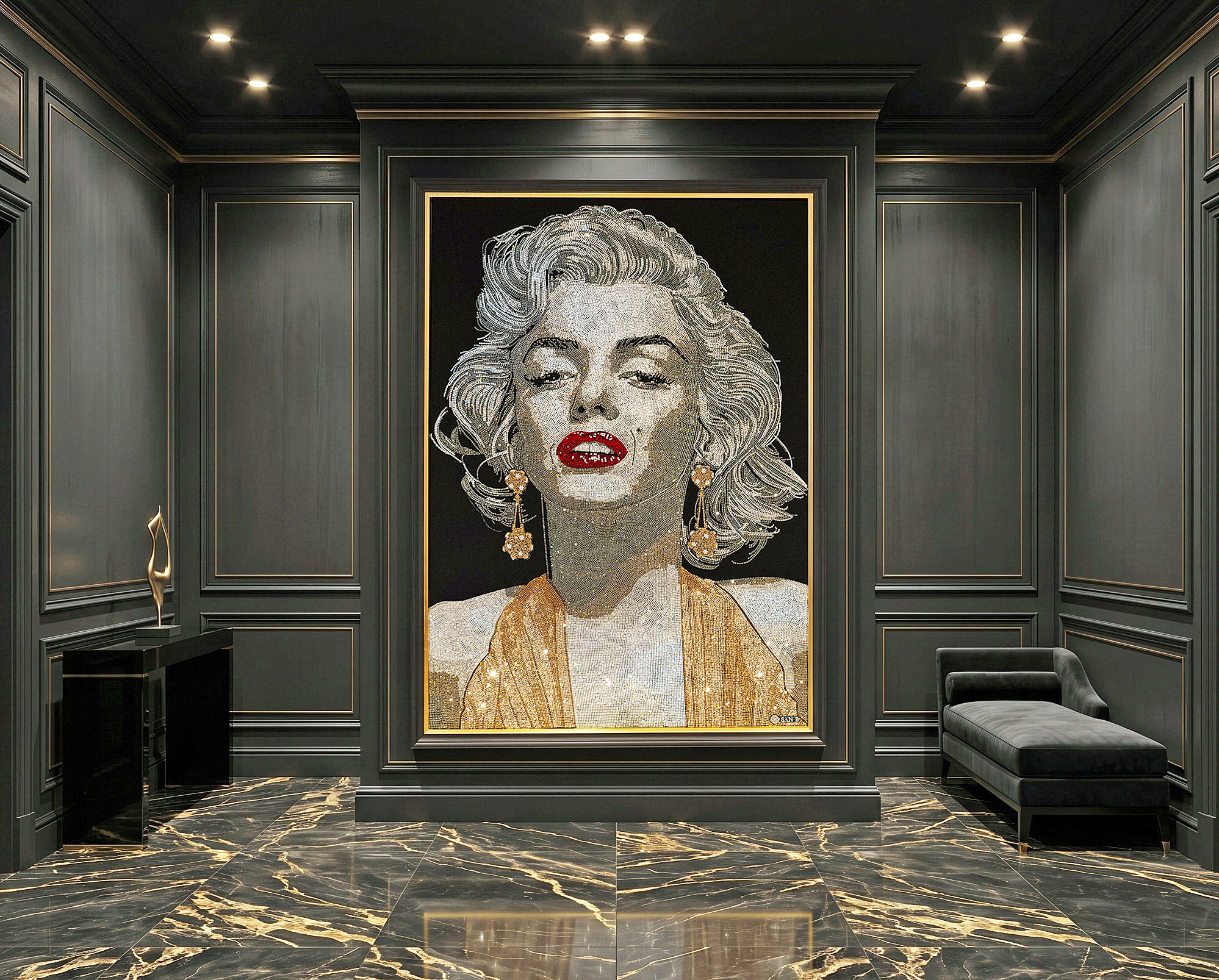
By any conventional measure, Marilyn Monroe should have faded into nostalgia long ago. She belonged to black-and-white cinema, to studio-era Hollywood, to a media ecosystem that no longer exists. Yet as the world approaches the centenary of her birth in 2026, Monroe remains one of the most commercially potent and culturally enduring figures ever created. Not merely a celebrity, but a global intellectual property asset whose image continues to generate fascination, revenue, reinvention, and debate.
That point will come into focus this June in London with the unveiling of Marilyn Monroe: Immortal, currently the only centenary artwork officially approved by the Marilyn Monroe Estate. Created by British contemporary artist San B, the museum-scale portrait features more than 150,000 Swarovski® crystals and Swarovski® Created Diamonds, each placed by hand over more than 1,000 hours.
At first glance, the piece seems to celebrate glamour. More deeply, it signifies what truly endures.
The unveiling arrives at a moment when the economics of legacy have become increasingly central to entertainment, fashion, luxury, and technology. Monroe’s likeness continues to appear in campaigns, exhibitions, collectibles, licensing partnerships, and digital reinterpretations decades after her death. Her estate, managed under Authentic Brands Group, understands what many modern corporations are only beginning to appreciate: image, when protected and culturally nurtured, can outlive biography itself.
That makes Monroe less a relic of old Hollywood than an early prototype of the modern creator economy.
Today’s influencers spend enormous amounts of time attempting to engineer the kind of symbolic permanence Monroe achieved almost accidentally. They optimise visibility, cultivate aesthetics, and monetise identity across platforms designed for velocity rather than longevity. Yet most digital fame evaporates quickly. Monroe’s image, by contrast, has endured for generations because it transcended content. It became mythology.
This is precisely the tension San B explores in Marilyn Monroe: Immortal.
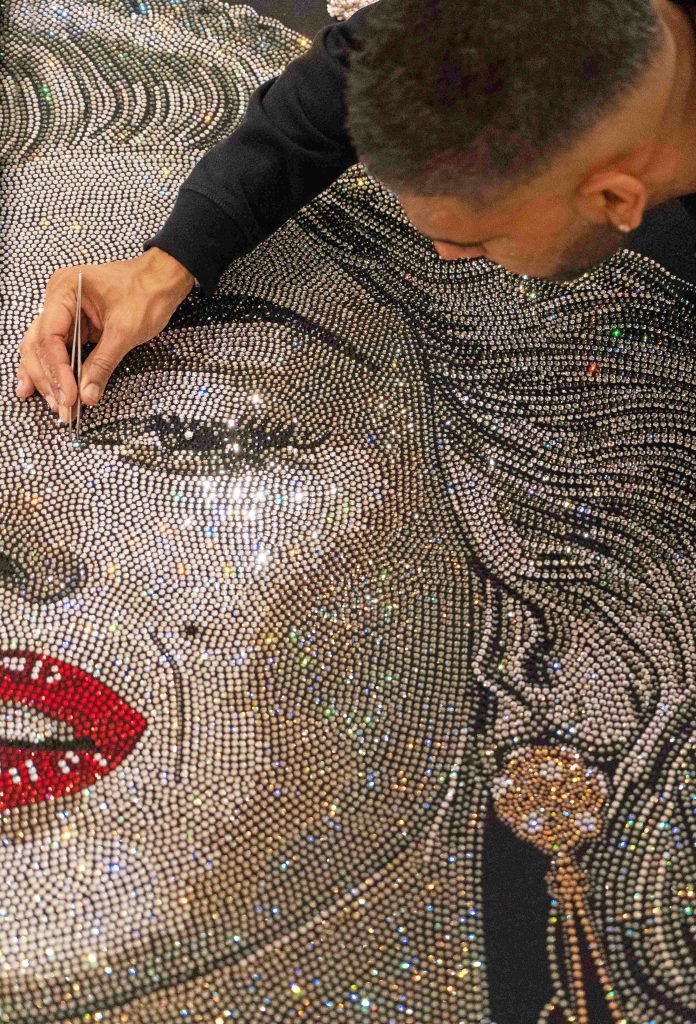
The East London-born artist, whose previous works include portraits of Queen Elizabeth II for Rolls-Royce and commissions featuring global celebrities such as Anthony Joshua and Bruno Mars, has built a reputation for using crystallization not simply as decoration but as metaphor. In this work, Monroe’s brilliance is rendered literally through refracted light, while the stark black background symbolizes the emotional fragility of Norma Jeane—the private individual obscured behind the public construct.
That duality feels especially contemporary.
Modern audiences increasingly understand celebrity not as aspiration alone, but as performance under pressure. Monroe’s life foreshadowed many of today’s conversations around mental health, public scrutiny, image ownership, and the commodification of identity. In that sense, her centenary is not just a nostalgic milestone. It is a mirror.
The business world should pay attention to why Monroe still commands relevance.
Luxury brands have long understood that scarcity and symbolism drive value. But Monroe represents something even more powerful: emotional familiarity at a planetary scale. Few individuals in history have achieved such immediate recognizability while remaining open to reinterpretation by each generation. She can simultaneously symbolize glamour, vulnerability, ambition, exploitation, femininity, reinvention, and fame itself.
That elasticity is the foundation of enduring brand equity.
The fact that San B’s work is a one-of-one-piece matters. In an era increasingly dominated by infinitely reproducible digital imagery, exclusivity regains power. The artwork’s painstaking manual construction also pushes against the speed of algorithmic culture. More than 150,000 individually placed crystals create not just an image, but an act of devotion and precision, an argument that craftsmanship still carries emotional and commercial weight in an age of instant production.
Importantly, the unveiling also binds cultural capital to social impact. A private auction scheduled for July 2, will direct a percentage of proceeds to Caudwell Children and the Caudwell Youth Foundation, organisations that support disabled and autistic children, as well as troubled young people experiencing violent living environments and the many challenges of modern urban living.
That philanthropic dimension also reflects a broader evolution in legacy building: audiences now expect cultural prestige to be accompanied by social responsibility, alongside commercial value.
San B himself represents a distinctly contemporary entrepreneurial narrative. Born in Forest Gate to a Sikh family and shaped by both architecture and the restless multicultural energy of East London, he belongs to a generation of creatives moving seamlessly across art, commerce, luxury, branding, and philanthropy. The traditional distinctions between artist, entrepreneur, and cultural strategist continue to dissolve.
Perhaps that is Monroe’s true significance at 100. Her enduring presence reveals that immortality in the modern age is neither accidental nor solely artistic. It is shaped through narrative stewardship, emotional resonance, the strategic protection of identity, and continual reinvention across mediums and generations.
Most celebrities fade when the culture that produced them shifts.
Marilyn Monroe transcended the culture that first defined her. A century later, that may be the most enduring business lesson of all.