
The wellness industry has built a $6.8 trillion market for adult stress. Teenagers are in crisis and nobody is building for them.
The wellness industry has become very good at selling calm to adults.
Adaptogenic lattes, magnesium supplements, breathwork apps, sleep trackers, beautifully packaged journaling kits. The global wellness market reached $6.8 trillion in 2024, a record high, forecast to grow to $9.8 trillion by 2029, according to the Global Wellness Institute’s 2025 Economy Monitor. It was built largely on the premise that adults are overwhelmed, burnt out and in desperate need of tools to help them slow down.
That premise is correct, the tools work, the market has responded and the industry has executed brilliantly.
But there is a gap nobody is talking about, a generation that is, by every measurable indicator, in the middle of the worst mental health crisis in modern history and the wellness industry has largely built nothing for them, I’m talking about teenagers.
Teen Mental Health by the Numbers: What the Data Actually Shows
The rate of hospital admissions for self-harm among 10-to-14-year-olds more than doubled in a decade, from 124 to 307 per 100,000, according to NHS Digital and the Nuffield Trust. The prevalence of eating disorders in children aged 11–16 increased fivefold between 2017 and 2023, rising from 0.5% to 2.6%, with girls specifically rising from 0.9% to 4.3%, per the NHS Mental Health of Children and Young People Survey 2023. One in five children and young people aged 8–25 now has a probable mental disorder, with anxiety referrals for under-17s more than doubling in five years, from 98,953 before the pandemic to 204,526 in 2023–24, per NHS England and the Children’s Commissioner for England.
The leading driver, the factor appearing consistently across every study, every professional body, every parenting survey is the same: the smartphone and the social media ecosystem that lives inside it.
The UK government has begun to respond, new social media age restrictions for under-16s represent the most significant regulatory intervention in children’s digital lives in a generation. The message from policymakers is clear, the current situation is causing harm and something fundamental has to change.
And here is the problem nobody in the wellness industry is yet addressing, when you restrict a teenager’s access to the primary mechanism they have used for years to manage social connection, identity and emotional processing you create a vacuum. The question the wellness industry should be asking, urgently, is what fills it?
The wellness industry has seventeen solutions for adult anxiety ready by Tuesday. For a 13-year-old in crisis, it has almost nothing.
Why Adult Wellness Products Don’t Work for Teenagers
If you’re an adult experiencing anxiety, the wellness market has you covered. Adaptogens to balance your cortisol, a magnesium spray for your sleep, a breathwork app for the commute, a thoughtfully designed journal that prompts you to name three things you are grateful for.
These are genuinely useful tools, but they are adult solutions to adult problems and the adolescent experience of anxiety is categorically different.
Teenagers don’t want to be guided by an algorithm, they don’t want to download another app, they do not want to be told by an adult in any format (however beautifully packaged) how to feel or how to cope. The research on adolescent psychology is consistent: young people are most receptive to peer-voiced support, communication that sounds like someone their own age, not a framework, and not a wellness brand speaking with its authority voice.
This is the design problem the industry has not solved, the tools exist, the market appetite is there, but nobody has done the hard work of genuinely designing them from a young person’s perspective with a young person’s voice at the centre, not bolted on as an afterthought.
What the Evidence Shows Actually Works for Young People
The evidence on what supports teenage mental health points clearly in a few directions, peer connection and peer-voiced communication, physical, tangible tools rather than screen-based ones, prompts rather than prescriptions and crucially, something that doesn’t feel like therapy.
The irony is that everything the adult wellness market is celebrating right now, the return to physical products, journaling culture, card decks, offline rituals, intentional tactile tools, these work for young people too. The research supports it, the demand is there, the gap is that nobody has designed them with an authentic teen voice.
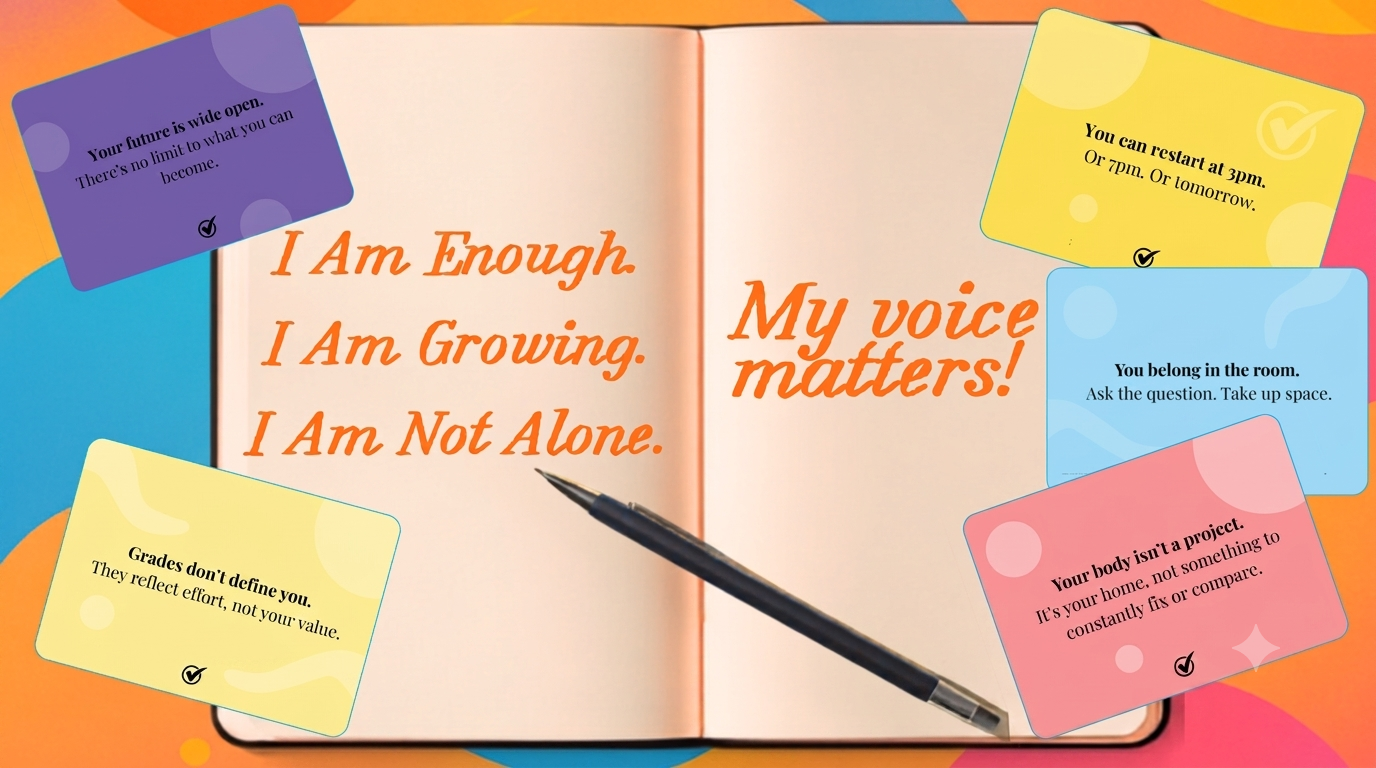
I saw this first-hand, my son is 12 and after a period of feeling overwhelmed and not good enough playing competitive football for his school and feeling, as he put it, ‘too small for the situation’ he created a deck of 52 affirmation cards for pre-teens and teenagers, written in teen language, covering exactly the territory the wellness industry has not reached: anxiety, exam stress, body image, social media pressure, peer pressure, self-confidence.
He didn’t design them to sound like a wellness product, he designed them to sound like a friend. When they were shared with the Headteacher and Head of PSHE at his school, both said the same thing: these cards open conversations that teenagers struggle almost impossibly to start on their own. That is the real measure, not beautiful packaging or expert-endorsed frameworks, but conversations teenagers actually choose to have.
The generation navigating the first post-smartphone era will be consumers for decades. They will remember who saw them when they were 13 and struggling.
Four Things the Wellness Industry Must Get Right for Teenagers
The next frontier for wellness is not a better adaptogen or a more sophisticated biometric tracker, it’s something more fundamental, accessible, offline, peer-voiced tools for young people that meet them where they are, overwhelmed, slightly ashamed of feeling that way and not remotely interested in being marketed to. The brands that move toward this audience first will find something the current market rarely offers: genuine unmet need.
Authenticity over aesthetics, a beautifully designed product means nothing to a teenager if the language does not feel true. The current wellness visual language (clean lines, aspirational imagery, expert-endorsed copy) reads as adult, young people respond to honesty over polish and they can spot inauthenticity faster than any other consumer segment.
Physical over digital, counterintuitively, the generation that grew up with smartphones is hungry for offline experiences. The card, the notebook, the physical object, these carry a different weight precisely because they are not a screen and that distinction matters to young people more than most adult consumers realise.
Peer-voiced over expert-endorsed, clinician and educator endorsements matter to parents making purchasing decisions. To teenagers, what matters is whether something sounds like someone who genuinely gets it, not a professional, not a teacher and not a well-meaning adult trying very hard to relate. The brands that get this right will earn trust that is almost impossible to buy through advertising.
Price accessibility is also an important aspect, the adult wellness market has drifted upmarket over the past five years, a £40 supplement stack or a £120 retreat weekend is not accessible to a teenager and often not a reflexive purchase for families already managing the cost of raising children. The tools that reach young people need to exist at a price point that requires no second thought.
Why the Wellness Industry Cannot Afford to Keep Looking Away
The teen mental health crisis will not be solved by removing smartphones alone, restriction is necessary, but it is not sufficient. The vacuum that policy creates has to be filled and right now, the wellness industry is largely watching from the sidelines, still focused on optimising the adult market it already owns.
That is a missed opportunity and more than an opportunity, it is a responsibility.
The brands, founders and innovators who turn toward this audience now, with honesty, with offline tools, with peer-voiced communication and accessible price points will be building something the market genuinely needs, not a trend to ride or a gap to fill.
The generation asking for help is already there. The question is whether the industry is paying attention.
About the author
Patrizia Galeota is a PR specialist and podcast host (PR LIKE A BOSS!), with 20+ years’ experience . Based in London, she helps brands and founders build media visibility. She is also the mother of Marco Ruggieri, age 12, founder of ENOUGH AS YOU ARE™, a youth wellbeing brand whose 52-card affirmation deck is endorsed by senior educators at Belmont, Mill Hill. www.enoughasyouare.co | info@patriziagaleota.com