
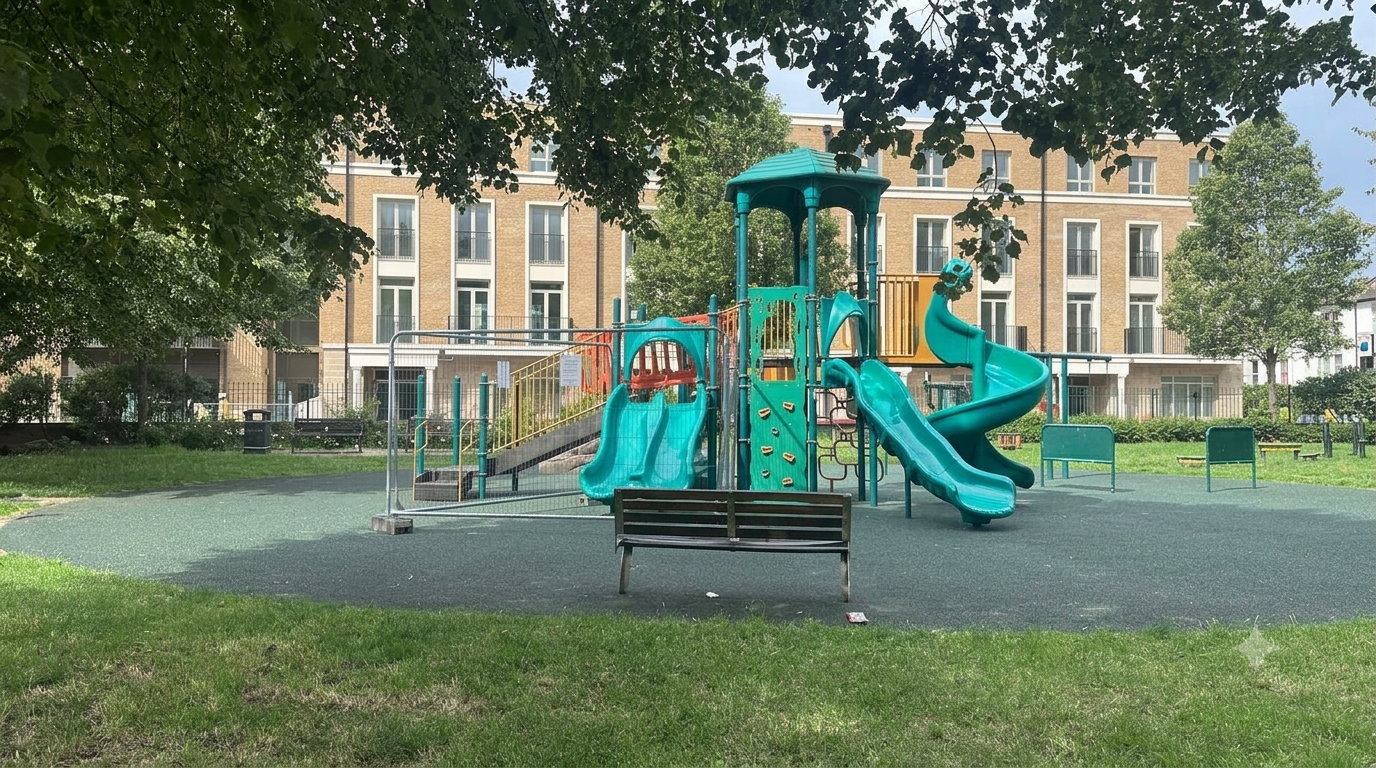
Imagine it is a Sunday morning in London’s Fulham area. Bishops Park Playground sits almost empty. The slides are unused, the swings hang still, and the usual noise of children playing has been replaced by the sound of adults running along the river path.
It is a small scene, but it points to a much larger shift. Across many wealthy cities, children are becoming less visible in daily life. The places built around family routines, school runs, playgrounds and casual neighbourhood life are being reshaped around smaller households, later adulthood and more solitary ways of living.
This is not simply a story about falling birth rates. It is a story about what happens when demographic change becomes visible in the design of everyday life. Cities are where the demographic story becomes a lifestyle story: in the places people live, eat, drink, exercise and gather. Increasingly, many are being rebuilt not just around adults without children, but around a changing version of adult life itself.
How Falling Birth Rates Are Changing City Neighbourhoods
San Francisco offers one of the clearest previews of this future. City data shows its child and young adult population fell between 2010 and 2020, even as the city’s total population grew, while 2020 Census analysis found San Francisco had the smallest share of children among the 100 most populous US cities.
On the surface, this is a housing story. Home prices in San Francisco rose sharply between 2000 and 2020, and much of the new housing being built was aimed at smaller households. Studios and one-bedroom apartments suit young professionals, older singles and high-earning couples.
Neighbourhoods are not neutral places; they respond to the people who live in them. A playground works differently when there are fewer children to fill it. A high street changes when the morning rhythm is less school run and more coffee run.
But cities change slowly, through thousands of small decisions that add up over time: smaller apartments, fewer family-sized homes, more boutique fitness studios, and fewer casual spaces that assume messy, intergenerational life.
Why Social Spaces Are Shifting From Pubs to Fitness Clubs
Cities are not just changing because there are fewer children. The way adults spend their time, and where, is also evolving. BBPA reported in 2026 that 161 pubs closed across England, Scotland and Wales in the first quarter of the year, the equivalent of almost two a day. Pubs and bars are places where people gather without needing a formal plan, where regulars are known, and where friendship, dating, celebration and community overlap.
Those spaces are under pressure. Pub closures have continued, driven by rising costs, changing habits and a younger generation drinking less than those before them. At the same time, gyms, boutique studios and wellness spaces are becoming more central to how adults structure their social lives. In the UK, gym membership has reached record levels, with ukactive reporting 12.2 million members over the age of sixteen in 2026 and visits up 10 per cent.
This does not mean the gym has simply replaced the pub. It means the need for community has moved into a different kind of space. The pub offered loose connection, while the boutique studio offers organised belonging: the same instructor, the same class time, the same faces, the same ritual every week.
That distinction matters. Fitness is often described as individualistic, and in some ways it is. People arrive with headphones, track their progress, optimise their bodies and leave with data about what they have achieved.
But boutique fitness also gives people something many adults are missing elsewhere: repeated contact. It creates a reason to show up at the same place, at the same time, with people who share a routine. In a city where fewer lives are organised around school gates, family networks or local institutions, that repetition starts to matter.
In the US, boutique fitness is also a premium version of community, with industry pricing analysis putting unlimited studio memberships at around $110 to $360 a month, meaning belonging itself becomes part of the lifestyle economy.
A Pilates class, running club or strength-training group offers connection and routine. But they also change what community means, making it more scheduled, curated and expensive. The adult city is not losing the desire to gather. It is turning gathering into something structured, branded and paid for.
How Restaurants Are Adapting to Solo Living
Restaurants are changing too. In the United States, takeout and delivery now account for a large share of restaurant traffic, and in many cities the bar seating that once hosted regulars and conversation has become a waiting area for delivery bags. Eating is still social, but the systems around it increasingly assume convenience, speed and individual choice.
Solo dining has also become more visible. OpenTable data reported by the Associated Press found that US solo dining reservations rose 29 per cent over two years, with increases also recorded in Germany and the UK. That can be liberating, especially in cultures where eating alone was once treated as embarrassing or undesirable.
But the trend also tells us something about the city being built around us. Restaurants no longer only need to accommodate couples, families, birthdays, friendship groups and after-work tables. They also need to accommodate the adult who wants to be around people without necessarily being with people. More counter seating, smaller tables and faster service answer the needs of adults in a city adapting to solo life. The spaces are not necessarily lonely, but they are increasingly designed for people moving through the world independently.
What Japan and South Korea Reveal About Solo Urban Life
Japan has been living with this future for longer than most. Japan’s National Institute of Population and Social Security Research projects single-person households will account for 44.3 per cent of all households by 2050, with the average household size falling below two people in 2033. Restaurants with individual dining booths, convenience stores built around single portions and karaoke rooms for one all reflect a society already adapting to smaller households.
From the outside, this can look like a preference for solitude, but that misses the larger point. A solo economy does not emerge simply because people decide they like being alone. It emerges when enough people are living, eating, working and ageing outside the family structures that once organised daily life.
The OECD notes that Korea’s fertility rate fell to 0.72 children per woman in 2023, the lowest in the world and well below replacement level. Its model of adulthood is being shaped by delayed marriage, high housing costs, intense work culture and rising single-person households.
Both Japan and the UK have appointed ministers focused on loneliness in recent years. That is quietly significant. It suggests that governments are beginning to recognise that the social fabric of daily life has changed.
What Cities Lose When Children Disappear From Daily Life
The 40-year-old without children, the 20-year-old gym-goer and the 30-year-old solo diner are all responding rationally to the world around them. Those choices are beginning to reshape cities. Children change the atmosphere of a place. They make it louder, slower, less controlled and less efficient.
They bring buggies into cafes, scooters onto pavements, and birthday parties into restaurants. They force public life to accommodate interruption. Children make cities more human because they make them less optimised.
A city with fewer children may become cleaner, quieter and more convenient. It may have better coffee, better gyms, better dining choices and more apartments designed for one. But cities may also lose something harder to measure: a feeling. A sense of continuity, and a daily reminder that the future is not theoretical.
Why Falling Birth Rates Are Already Reshaping Everyday Life
Falling birth rates are usually discussed as an economic problem. Too few workers, too many retirees, and too much pressure on pensions, healthcare and tax systems. Those issues matter, but they are not where most people will feel demographic change first.
The cities of the future may be full of parks that are quieter, pubs converted into apartments for one or two adults and restaurants designed around delivery before conversation. That is the lifestyle story of falling birth rates.
From San Francisco to Seoul the same pattern is appearing at different speeds. Fewer children, fewer buggies, more coffee shops, more wellness spaces and more adults moving through the city alone. These places will not necessarily feel empty. They may be busy, polished and full of choice. But something changes when a city is built less around the next generation, and more around the adults already here.
ABOUT THE AUTHOR
Chloe Alana Williams is a writer and cultural demographer with twenty-five years of research experience. Her work examines the cultural, economic and political forces behind falling birth rates and their consequences for how adulthood, relationships and society are being reorganised.
Sources
SF.gov
Child and young adult population by age and race
KALW
San Francisco has lowest share of kids of any major U.S. city
The Drinks Business
Two pubs close a day in UK despite rates relief
ukactive
UK Health and Fitness Market Report 2026
FitDegree
How to Price Fitness Studio Memberships Without Leaving Money on the Table
CBS News / Associated Press
Party of one: Restaurants are catering to a growing number of solo diners
Nippon.com
Single Elderly to Be 20% of Japanese Households by 2050
OECD
Korea’s Unborn Future