
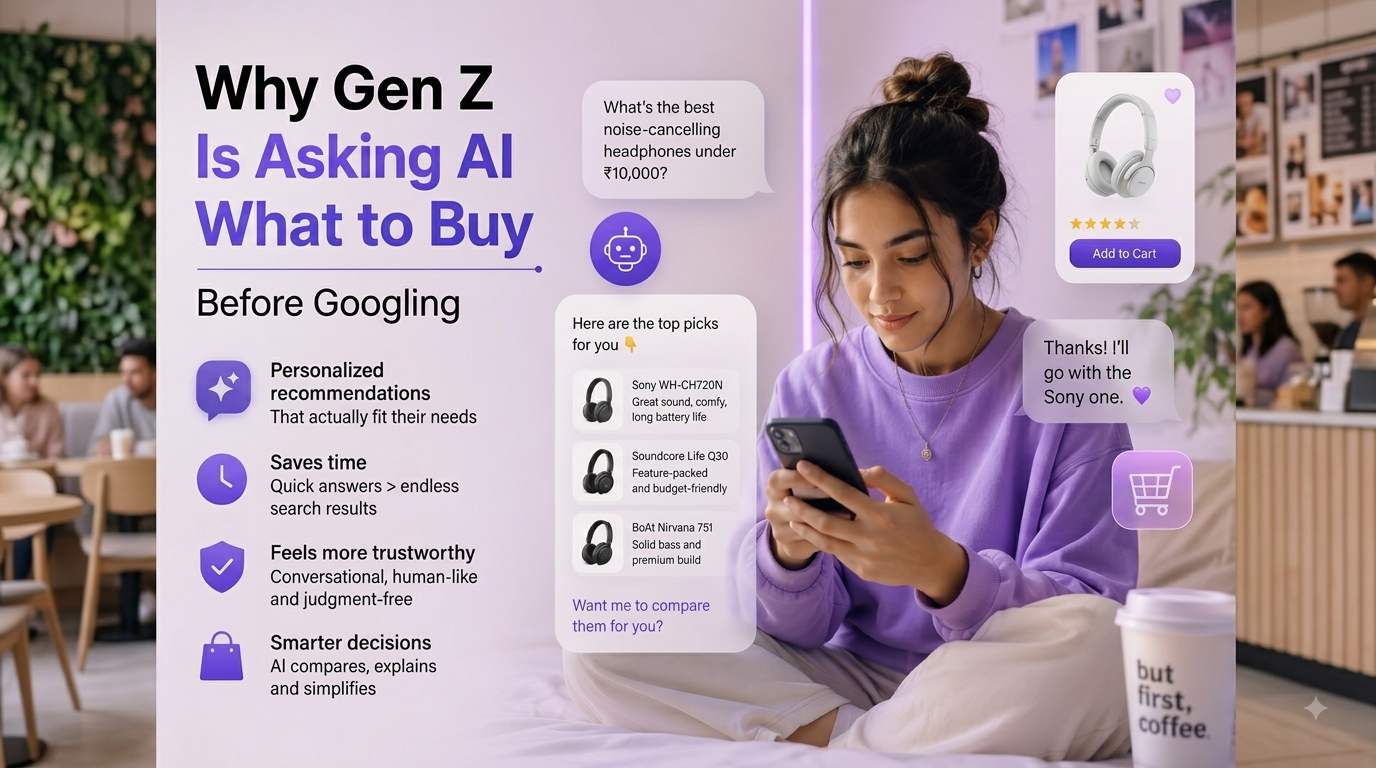
Watch a Gen Z shopper research their next purchase and you will notice something quietly historic. They are not typing keywords into a search bar and clicking through ten blue links. They are having a conversation. “Compare these three sneakers for daily wear.” “Summarise the reviews for this serum what do people actually complain about?” “I have a ₹15,000 budget and sensitive skin. What should I buy?”
The answer comes back in seconds: filtered, comparative, personalised, and confident. No ads to skim past. No thirty tabs. No SEO-engineered listicles pretending to be advice.
This is not a niche behaviour anymore. It is the beginning of a structural rewiring of how an entire generation discovers brands and most companies have not yet realised that the front door of their business has moved.
The Search Bar Was Built for a Different Generation
To understand why Gen Z is defecting from traditional search, you have to understand what search actually asked of the user. Google gave you links; the cognitive labour was yours. You clicked, compared, cross-referenced, filtered the sponsored from the sincere, and assembled your own answer. For twenty years, we accepted that labour as the price of information.
Gen Z grew up watching that price inflate. They came of age inside an internet crowded with affiliate content, engineered reviews, and search results optimised for algorithms rather than humans. Their response was rational: they began routing around the noise. First toward social search TikTok and Instagram as discovery engines and now toward AI assistants, which do something neither Google nor social ever did. They synthesise.
The data confirms the shift is generational and global. Capgemini’s consumer research found that 71% of consumers now want generative AI integrated into their shopping experiences, with Gen Z and millennials driving the demand and, more strikingly, that a majority of consumers have already begun replacing traditional search engines with generative AI tools when they want product and service recommendations, a figure that has more than doubled in just two years. GWI’s research shows Gen Z is the generation most likely to reach for AI chatbots to find information for older generations, AI remains a novelty; for Gen Z, it is becoming a default. And Adobe’s analytics tell us where this behaviour lands: AI-referred traffic to retail sites has grown explosively since late 2024, and this is the part that should make every CMO sit up those AI-referred visitors now convert better than visitors from traditional channels. They arrive pre-researched, pre-convinced, and closer to a decision.
In other words, AI is not just a new channel. It is a better-qualified one.
The Deeper Reason: This Is Psychology, Not Technology
It is tempting to explain this shift as a technology story. It is really a trust and cognition story.
Every purchase decision carries three hidden costs: the time to research, the anxiety of choosing wrong, and the exhaustion of too many options. Gen Z is the most choice-saturated generation in history thousands of near-identical products, each with a thousand conflicting reviews. Psychologists call the result decision fatigue. Gen Z calls it Tuesday.
An AI assistant attacks all three costs at once. It compresses research from hours to seconds. It reduces the fear of a wrong choice by explaining its reasoning. And it collapses infinite options into a shortlist. When a tool removes anxiety from a decision, people do not just use it they become loyal to it.
There is also something subtler happening. A search engine is a directory; an AI assistant feels like an advisor. It remembers your constraints, speaks your language, and doesn’t appear to be selling you anything. For a generation that is deeply literate in advertising and deeply allergic to it that perceived neutrality is magnetic. Whether that neutrality is complete is a fair debate. But in consumer behaviour, perception moves first and markets follow.
The Rise of the Parallel Consumer
Here is the reframe I offer every founder and CMO I meet: your brand no longer has one consumer. It has two.
The first is the human the person who will wear the shoe, drink the coffee, book the trip. The second is what I call the parallel consumer: the AI system that reads about your brand, evaluates your reputation, weighs you against competitors, and decides whether to recommend you, all before the human ever sees your name.
This parallel consumer never sleeps, never watches your ads, and cannot be charmed by a billboard. It “shops” your brand by reading everything the internet says about you; your website’s clarity, your reviews, your press, your comparisons, your consistency across sources and compresses it into a verdict delivered in a chat window. When a Gen Z shopper asks an assistant, “What’s the best budget running shoe?”, a private evaluation of the entire category has already occurred, and only three or four names survive it.
This is the most consequential change in brand visibility since the invention of the search engine, and it demands a new question. For two decades, brands asked: Do we rank? The new question is: Are we retrieved, understood, and recommended? At Markgrid, we call this a brand’s Share of Model™, how present, accurate, and favourably framed a brand is inside the AI systems consumers now consult. It is becoming to this decade what share of search was to the last one. A brand can have beautiful stores, strong products, and a healthy ad budget, and still be effectively invisible in the layer where a growing share of purchase decisions now begins.
What This Means for Brands and for Marketing Itself
The strategic implications are larger than most marketing plans currently acknowledge.
Visibility becomes semantic, not just spatial. In the search era, visibility meant occupying a position on a results page. In the AI era, visibility means being understood, having clear, consistent, machine-readable information about what you sell, whom you serve, and why you are credible. Ambiguity, contradiction, and thin content don’t just hurt your SEO anymore; they confuse the systems that decide whether you exist in an answer.
Trust becomes your distribution. AI assistants synthesise reputation. Reviews, expert commentary, community discussion, and press are no longer scattered signals, they are raw material for the recommendation engine. A brand’s honest track record now compounds in ways advertising never could, and a brand’s unresolved complaints follow it into every AI conversation. In the AI-mediated market, integrity is not a virtue statement. It is infrastructure.
The funnel inverts. Marketers spent decades designing journeys from awareness to consideration to purchase. AI collapses that journey: the assistant handles awareness, consideration, and comparison in a single exchange, and the human enters at the decision stage. This is why AI-referred shoppers convert so well, the middle of the funnel happened inside the model. Brands must now win a conversation they were never invited to.
And marketing teams must learn to market to machines. This does not mean gaming algorithms, that era is closing, not opening. It means treating AI systems as a legitimate audience with legitimate standards: accuracy, structure, evidence, and consistency. The brands that feed the ecosystem honest, well-organised truth will be the brands the ecosystem recommends.
The Human Ending to a Machine Story
There is an irony at the heart of all this. Gen Z is turning to machines for shopping advice not because they love machines, but because they are searching for something the modern internet stopped providing: a straight answer from something that isn’t trying to manipulate them.
That is the real lesson for brands, and it is an old one wearing new clothes. You cannot advertise your way past an intelligent intermediary. You can only be the brand that survives honest evaluation, clear about what you offer, consistent in how you show up, and genuinely good at what you do. The parallel consumer is, in the end, the most demanding critic brands have ever faced: one that reads everything, forgets nothing, and answers instantly.
Gen Z didn’t just change where they search. They changed what it takes to be found. The brands that understand this in 2026 will own the shelf that matters most in 2030, the one inside the answer.