
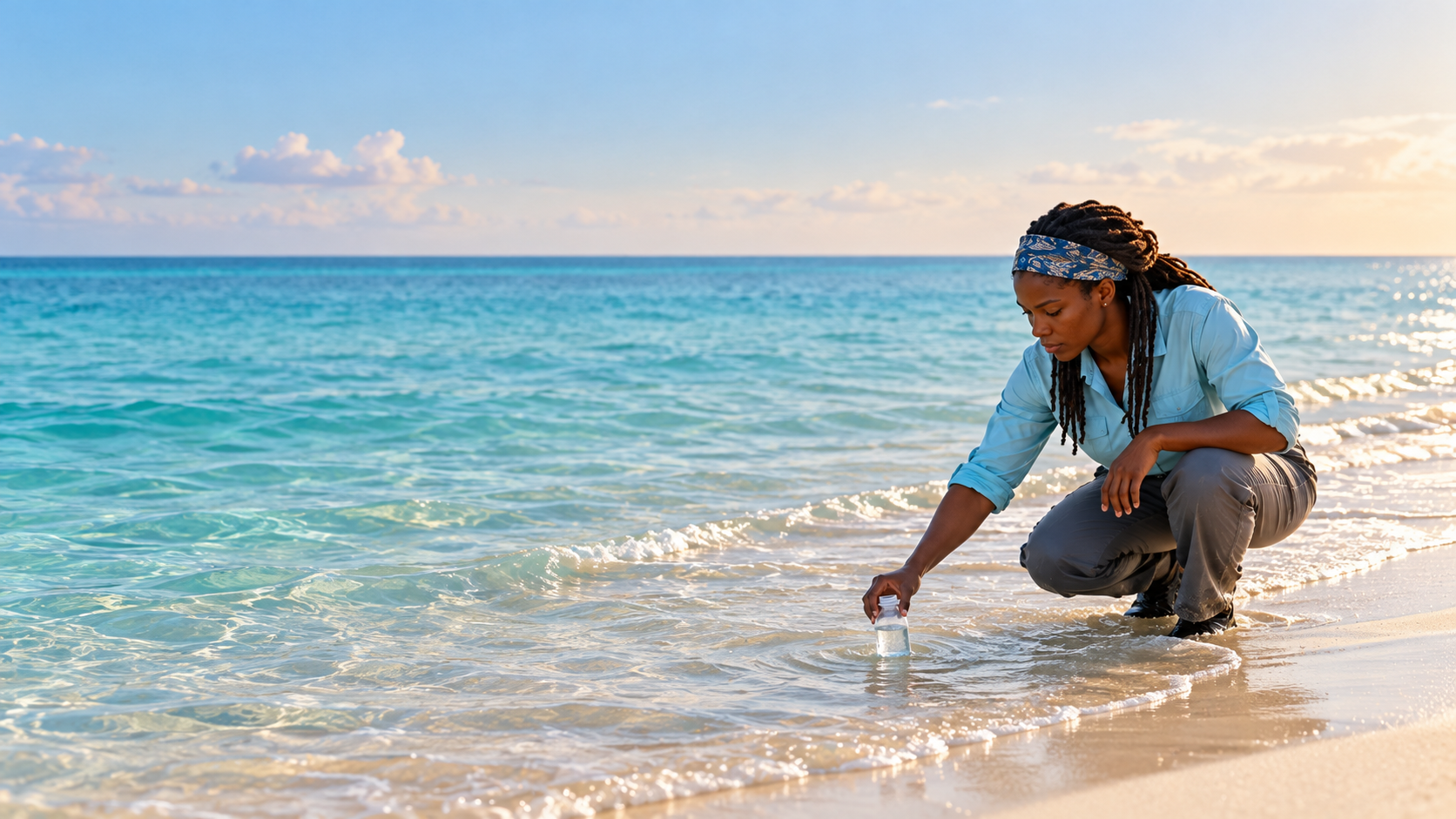
Travelers see the beaches, hotels and sunsets. They rarely see the people protecting them. That needs to change.
Think about the last trip you planned. You probably looked at photos of the beach, scrolled through hotel reviews and saved a few restaurants. What you almost certainly didn’t see were the volunteers who test that beach’s water every week, or the scientists tracking how fast the dunes behind your hotel are disappearing.
That’s not your fault. It’s how destinations get sold.
Destination marketing is very good at showing a place at its most beautiful. It’s much worse at showing who keeps it that way. For us at OJAI, that gap matters, because the people doing that work hold some of the most useful knowledge a traveler could have about a place. And almost nobody can find it.
The Postcard Version of a Place
Most destination campaigns are built from the same ingredients: sunsets, pools, food, a few attractions and a headline about paradise. None of that is wrong. Travelers want to know where they’ll sleep and what they’ll do.
But a postcard is a freeze-frame. It doesn’t show a reef that has bleached three summers in a row, a marsh a local group has been replanting by hand, or the fight over a seawall that has dragged on at city hall for a decade. Those stories are part of the place too. They’re the parts that decide whether the postcard still looks the same in twenty years.
Travelers are asking for that fuller picture. In Booking.com’s 2024 sustainable travel research, which surveyed more than 31,000 people across 34 countries and territories, 68% said they want to leave the places they visit better than they found them, up from 60% the year before. People want to do the right thing. They just rarely get shown how.
Who Is Watching the Coastline
Behind almost every popular destination, someone is keeping score. Volunteers measure bacteria at swimming beaches. University teams map shoreline retreat. Neighborhood groups log illegal dumping, count nesting turtles and track which wetlands are coming back.
Some of this work runs at real scale. Surfrider Foundation’s Blue Water Task Force runs more than 60 chapter labs that test water at over 600 sampling sites, and it’s powered by volunteers. On the erosion side, the federal U.S. Climate Resilience Toolkit puts coastal property losses from erosion at roughly $500 million a year. The people measuring that loss, one site at a time, are usually local.
A lot of this knowledge is built with communities, not just about them. Strong Coasts, a program I’m connected with, is a National Science Foundation-supported traineeship led by the University of South Florida and the University of the Virgin Islands. It trains graduate students to work alongside community partners on coastal food, energy and water challenges in Tampa, the U.S. Virgin Islands, Barbados and Belize. As the program points out, about 40% of the world’s population lives within 100 kilometers of a coast. That’s a lot of people whose daily lives depend on knowledge that rarely makes it into a travel brochure.
Most of this work is small and stubborn, though. A handful of people show up at the same marsh every month with a clipboard and a phone. Over the years, that adds up to something nobody else has: a real record of how a place is changing.
Where the Knowledge Gets Lost
Here’s the thing. That record usually exists, but it’s scattered.
It lives in a PDF report from five years ago, a spreadsheet on someone’s laptop, a project page nobody updates, a Facebook group and a grant report that only the funder ever read. When a volunteer coordinator moves on, a lot of that knowledge leaves with them.
We watched this happen for years before we started OJAI. Environmental groups weren’t short on information. They were drowning in it, spread across tools that were never built to talk to each other. If the organizations doing the work struggle to pull it all together, imagine being a traveler, a hotel manager or a tourism board trying to find it.
How a Map Changes the Conversation
Travelers already think in maps. They pick neighborhoods, plan routes and pin restaurants. So it makes sense to show environmental work the same way.
When a restoration project is a pin on a map instead of a paragraph buried in a report, it becomes easy to understand. You can see that the beach you’re staying on is two miles from an oyster reef being rebuilt. You can tap a water-quality site and see what volunteers found last week. You can watch erosion as a line moving inland over time, not just read it as a statistic.
Place-based information also travels well. A map can sit on a destination website, a hotel’s guest page or a nonprofit’s homepage, and it tells the same story in every one of those places.
Community Storytelling Brings the People Back In
Data alone doesn’t move most travelers. People do.
A water-quality reading means a lot more when it comes with a short video of the volunteer who has collected samples at that beach every Saturday for years. A replanted dune is more interesting when you hear from the students who planted it and came back each semester to film how it grew.
Storytelling gives visitors a reason to care, and it gives credit to the people who’ve earned it. For local groups, being seen isn’t vanity. Visibility brings volunteers, partners and funding, and those keep the work going.
Responsible Travel Needs Local Context
A lot of what gets called responsible travel focuses on the traveler’s own choices: reusable bottles, greener hotels, fewer flights. Those choices count. But they only go so far if visitors don’t understand the place they’re in.
The World Tourism Organization describes sustainable tourism as tourism that addresses “the needs of visitors, the industry, the environment and host communities.” Host communities are right there in the definition. Often, the people who understand a community’s environment best are the local groups already working on it.
Knowing that a river is struggling with nutrient runoff, or that a stretch of coastline washed away in last year’s storm, changes how you see a place. It turns a visitor into someone who actually understands what they’re looking at.
What Hotels and Destination Organizations Can Do
Some destinations already show what this can look like. Palau asks every arriving visitor to sign a pledge, stamped right into their passport, to “tread lightly, act kindly and explore mindfully,” as National Geographic reported when it launched. In Hawaiʻi, the Mālama Hawaiʻi program connects visitors with volunteer work like planting native trees and cleaning beaches, and partner hotels have offered perks such as a free night in return.
Hotels, tour operators and tourism boards don’t need a national campaign to start. A few practical steps go a long way:
- Feature local conservation groups on your website and in guest communications, in their own words and with their own photos.
- Put active projects on a map guests can explore before and during their stay.
- Share real ways to get involved, like a cleanup, a planting day or a guided walk with the people doing the work.
- Point guests to real local data, such as beach water-quality results, instead of vague green claims.
- Build long-term partnerships with these groups, not one-off campaigns.
Technology Should Support the People, Not Replace Them
I build technology for a living, so I’ll be clear about its limits. Software doesn’t restore a wetland. People do.
What technology can do is take the work communities are already doing and make it easier to organize, find and support. That’s why we built OJAI. It gives environmental organizations one place to map their projects, tell their stories with photos and video, share resources, and connect members and partners. Groups can embed those maps and stories on their own websites, so the work stays theirs.
My co-founder, Dr. Tiara Moore, founded Black In Marine Science (BIMS) in 2020 as a grassroots effort to connect and uplift marine scientists. It has since grown into a global nonprofit community with its own jobs board, funding database and resource library, and it uses OJAI to connect roughly 700 members around the world on a shared map. Seeing scientists, students and advocates find each other that way showed us how much changes when people can actually see who is doing the work, and where.
A Fuller Story Is a Better Story
Every destination is already telling a story. The question is whether it’s telling the whole one.
The beaches, the food and the views will always be part of it. So are the volunteers testing the water, the students replanting the marsh and the scientists tracking what’s changing. When destinations make that work visible, travelers understand where they are, local groups get the recognition and support they’ve earned, and the places we love get a better shot at staying that way.
That’s a story worth telling. It’s already out there, waiting to be mapped.