

Using generative AI, entrepreneurs are capable of completing the full range from initial concept to product launch much more quickly than ever before. This can be particularly helpful for lean teams that need to validate their ideas, conduct market research, develop product offerings, create marketing materials, support customers, and manage day-to-day operations without immediately having to hire a full-time staff.
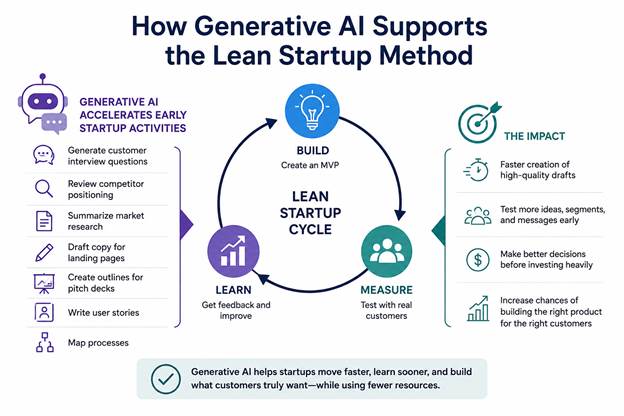
How Generative AI Supports the Lean Startup Method
The Lean Startup method utilizes rapid experimentation to learn about a business through creating a minimum viable product and testing with actual customers. Once a company has created its MVP, real customers provide feedback to improve upon it. Generative AI can accelerate this timeline for the majority of activities completed early in the startup lifecycle.
For example, by leveraging generative AI software, startups can generate customer interview questions, review competitor positioning information, summarize market research findings, draft copy for landing pages, create outlines for pitch decks, write user stories, and map processes. Instead of spending weeks developing and researching these deliverables manually, teams can generate initial drafts quickly for the purpose of refining them through human judgment.
This ultimately allows startups to evaluate more business ideas before committing large sums of money or significant amounts of time in product development. A small team can compare multiple customer segments, value propositions, product concepts, and price messages much earlier in their overall process than they could without the help of a generative AI tool.
Using AI to Reduce Time and Resources When Developing an MVP
AI has its greatest impact on lean startups in the area of rapid MVP development. With the use of these services, software development can now utilize AI-assisted programming environments to create code, generate documentation, create test cases, and develop product architectures. Founders without technical knowledge can also develop prototypes using low-code or no-code platforms, both of which are supported by AI, before they can recruit a complete engineering team.
In order to avoid overbuilding too quickly, founders must determine the most important workflow to focus on for their first MVP, rather than creating a fully defined platform from the outset. By limiting the first MVP to one workflow (such as onboarding, booking, and so on), founders can validate whether or not a viable market exists for those workflows, thereby eliminating the need to invest in a complete, large-scale prototype until there is evidence that a viable market exists for those roles.
At the same time, the founders also have to determine if generative AI will become an intrinsic part of their product. The use of generative AI without an explicit value will rarely create any positive impact. AI can be used to enhance and streamline a particular workflow, minimize pain points, improve the accuracy of results, provide a more customized experience, and ultimately be more beneficial in terms of the overall usefulness of a product.
Startups that already have beyond the stage of building an early prototype will find it easier to work with established developers for assistance in developing their generative AI solutions. For example, companies such as Cleveroad provide generative AI development services and support startups in developing generative AI applications such as AI assistants, chatbots, large language model integrations, retrieval-augmented generation systems, and AI-powered business platforms. This becomes particularly useful for startups that require secure architecture, third-party integrations, scalable infrastructure, and production-ready generative AI functionality.
Customer Discovery & Validation
The critical aspect of starting your business is to conduct thorough customer discovery, and generative AI can improve this. Founders can perform analysis on their direct interview transcripts, survey results, online reviews, call logs of sales support tickets, and similar competitor’s sales messages. Finding repetitive issues, or complaints that customers have commonly regarding a product helps to fill out the founders’ understanding of their customers with regard to purchasing.
Discovering customer insights from this information creates better hypotheses before speaking with even more customers. For example, the hypothesis may exist that customers want a certain feature; however, the founders may determine from AI that perhaps they are less worried about ‘features’ than they are in relation to their time being saved, their risk being reduced, or increasing their visibility into a process.
That said, while AI should help with the customer discovery process, it may not eliminate the need for direct conversations/meetings with customers. AI should help provide either supportive but not ruling evidence regarding customer assumptions, and founders need to be able to confirm the accuracy of their assumptions by conducting live, direct interviews with their customers and performing product-testing, as well as collecting qualitative market feedback.
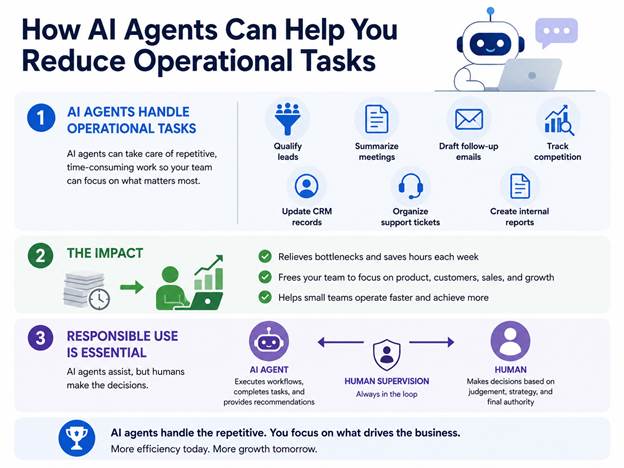
How AI Agents Can Help You Reduce Operational Tasks
AI agents can do great things at an early-stage company and provide tremendous assistance with repetitive type operational tasks. For example, you could use an AI agent to qualify leads, summarize meetings, draft follow-up emails, track competition, update CRM records, organize support tickets, and create internal reports.
By allowing the AI to assist in handling these tasks, small teams are able to relieve bottlenecks created by doing these tasks manually. Rather than spending hours on administrative tasks, startup founders and early team members are able to now spend most of the time they would have previously spent working on product development and building relationships with customers to now also focus on driving sales and driving growth.
This said, AI agents should still be used in a responsible manner. While an AI agent can offer assistance in executing workflows and producing recommendations, the AI should never be making independent business decisions without receiving human supervision. The optimal results of having an AI agent assist you with your operations is where an AI agent completes the repetitive steps and a human continues to make decisions based upon the judgement of his or her strategy for a business and final authority.
Speeding Up Marketing & Sales Experimentation
Generative AI also helps startups experiment with marketing and sales at a much higher speed. Founders can quickly create versions of landing pages, email campaigns, ad copy, blog outlines, product descriptions, sales scripts, and outreach messages.
This makes it easier to test different customer segments and value propositions. A startup can compare whether one audience responds better to cost savings, speed, convenience, security, automation, or another benefit. Instead of relying on one message, teams can test multiple angles and refine their positioning based on real engagement.
However, because AI-generated content is now everywhere, generic messaging is easier to spot. Startups still need original insights, a distinct point of view, a clear brand voice, and strong positioning. AI can accelerate content creation, but differentiation must come from the company’s understanding of its market and customers.
AI Startups on the Rise in Vertical Markets
Rather than developing general use cases of generative AI, many new companies are creating products to address specific problems within one or more verticals (markets) like logistics, finance, healthcare, education, legal, retail and manufacturing, as examples.
For instance, a logistics company may create an AI assistant that helps track the status of shipments and determine where there are delays, as well as recommend solutions. A financial services company may employ AI to help review documents and identify missing documentation. A healthcare company may develop tools that summarize the information contained in patient intake forms. An educational company may create personalized learning recommendations for students based on their individual progression through coursework.
Vertical solutions typically provide more value than general-use AI solutions due to the domain-specific features that can be developed in these solutions (domain language, compliance/regulation, process/workflow, historical data, etc.) which makes them more useful for the day-to-day operations of the business.
AI Expenses Might Decline But AI Will Still Be Complex
While generative AI has allowed many startups to operate with much smaller teams and spent fewer resources on up-research, there are still many obstacles for founders to overcome. The requirements for effective start-ups continue to include consideration for costs associated with AI models, data security, customer data privacy, company compliance, reliability of systems and service delivery, truthful data (accuracy) and trust from users with regards to AI.
A good format question each startup can use to assess their potential value from adding AI is: will AI be able to make this process faster, cheaper, simpler, more customized, or more accurate for my customers? If it is determined to add value to the process by answering “yes” to one (or more than one) of these questions, then AI has added legitimate value; however, if it’s determined to lack value, then the goal may simply be providing a technology with no direct connection to providing a solution to a client’s problem.
Startups that successfully leverage the use of AI within their operations will not necessarily be the most complex, those utilizing the most advanced models; rather, the successful use of AI by the startup will be determined by how well-utilized AI in improving the customer’s experience and/or the efficiency of the business, and/or the value of the product being sold by the business.
Conclusions
Generative AI is proactively providing lean entrepreneurs with an edge in 2026. Generative AI has enabled founders to conduct their own research and test market concepts more quickly, use less resources when developing minimum viable product (MVPs), automate their routine tasks, and create more focused products targeting particular industries and markets than they would have otherwise been able to do.
However, AI is nothing more than a tool; it performs optimally when used in conjunction with a good understanding of the customer’s needs, rigorous validation of assumptions, well-defined positioning of the product in the market, and careful execution of market entry strategies. For entrepreneurs, the key opportunity is not only using AI but also strategically utilizing AI to produce better products with less waste than they otherwise could have done without it.
Author Bio
Yuliya Melnik is a technical author who is very enthusiastic about new technology and its long-term consequences. She likes to write content that makes complex concepts seem straightforward and encourages readers to be creative through vivid and meaningful narratives.