

On Disruption Interruption, DealSync Founder Shalom Ben Or explains why companies with complex revenue models can struggle to convert signed business-to-business deals into usable cash.
TAMPA BAY, Fla., Aug. 27, 2026 /PRNewswire/ — Secured finance is a massive market, with outstandings reaching approximately $12.2 trillion as of the fourth quarter of 2024 and annual transaction volume totaling $6.5 trillion, according to the Secured Finance Network. But that scale does not mean every business-to-business (B2B) deal can be turned into usable capital when companies need it. Atradius reported that 43% of credit-based B2B sales in the U.S. were overdue in 2025, primarily because of customer cash-flow pressure, underscoring the gap between financing capacity in the market and liquidity inside individual companies.
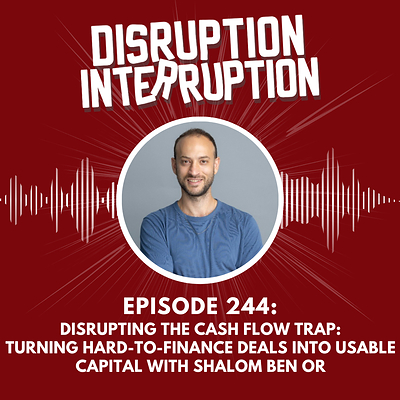
That gap is sharper for companies with complex or non-standard revenue models, where signed deals may not fit conventional revenue-based financing. On this episode of Disruption Interruption, host Karla Jo Helms (KJ) speaks with Shalom Ben Or, Founder of DealSync, about why Chief Financial Officers (CFOs) are often left reacting to sales-to-cash problems, why conventional revenue-based financing can break down for AI companies with outcome-based models, and how complex revenue can be structured as a financeable asset. “Currently, cash flow is managed,” Ben Or says. “It’s about time that software will make it programmable.”
Why B2B Revenue Still Gets Stuck
For Ben Or, the problem begins with the gap between closing a sale and turning that agreement into cash the business can use. Sales teams close deals, but finance teams still have to determine how payment terms, discounts, financing options, and working-capital needs affect liquidity.
As companies grow, they may add people and processes to manage deal desks, debt, treasury, and working capital. But many of the decisions still depend on context, judgment, meetings, and manual coordination.
When a company is not selling a straightforward subscription product, the problem becomes more pronounced. Ben Or estimates that B2B companies outside pure software-as-a-service models can have 20% to 30% of revenue tied up somewhere because of long payment terms, financing friction, discounts, or revenue that does not fit a lender’s standard underwriting model.
The conventional response is often to seek outside debt, but that can introduce another source of delay. “CFOs go to the places they know, which usually are not necessarily the right ones,” Ben Or says. “It’s a trap, because it takes too long to get what they want.”
Making Complex Revenue Financeable
DealSync was built around Ben Or’s argument that cash-flow decisions should become programmable rather than remain dependent on disconnected manual processes. He divides the CFO technology stack into three layers:
- Systems of Record: Hold financial information.
- Workflow Tools: Move tasks and approvals through finance processes.
- Judgment Layer: Support CFOs, treasurers, and controllers make higher-stakes decisions about debt, deal structure, and liquidity.
DealSync operates in the third layer, where CFOs make higher-stakes financial decisions. The platform helps companies identify revenue that is stuck between the sale and the cash, package it in a way lenders can evaluate, and connect with lenders who understand how to finance it. Ben Or says the company starts with debt because that is often the most urgent problem, but the larger opportunity is helping finance teams shape deals earlier, before sales terms create cash-flow problems.
That matters for companies that do not fit traditional lending models. Outcome-based AI businesses may get paid only after they deliver a defined result. Hardware companies may need capital to grow before revenue arrives. In both cases, standard revenue-based financing may not know how to value the opportunity.
“We are able to create an asset out of their revenue,” Ben Or says. That structure can give lenders a clearer basis for evaluating deals that might otherwise fall outside conventional financing models.
The goal is not to give finance teams another workflow tool, but to move financial judgment earlier in the process, so CFOs can understand the deal’s implications before a liquidity problem develops. “We want to make sure the CFO can control the cash flow at the onset,” Ben Or says, “not react to problems.”
Links
Disrupting the Cash Flow Trap: Turning Hard-to-Finance Deals into Usable Capital with Shalom Ben Or
Disruption Interruption is the podcast where you will hear from today’s biggest Industry Disruptors. Learn what motivated them to bring about innovation and how they overcame opposition to adoption.
LinkedIn: https://www.linkedin.com/in/shalombenor/
Company Website: https://dealsynchq.com
About Disruption Interruption™
Disruption is happening on an unprecedented scale, impacting all manner of industries — MedTech, Finance, IT, eCommerce, shipping, logistics, and more — and COVID has moved their timelines up a full decade or more. But WHO are these disruptors and when did they say, “THAT’S IT! I’VE HAD IT!”? Time to Disrupt and Interrupt with host Karla Jo “KJ” Helms, veteran communications disruptor. KJ interviews bad asses who are disrupting their industries and altering economic networks that have become antiquated with an establishment resistant to progress. She delves into uncovering secrets from industry rebels and quiet revolutionaries that uncover common traits — and not-so-common — that are changing our economic markets… and lives. Visit the world’s key pioneers that persist to success, despite arrows in their backs at www.disruption-interruption.com.
About Shalom Ben Or
Shalom Ben Or is the Founder of DealSync, a fintech company focused on making cash flow programmable for B2B companies with complex revenue models. His work centers on helping CFOs turn non-standard revenue into financeable assets by bringing AI-driven context into the judgment layer of the sales-to-cash process. Before DealSync, Ben Or built fintech experience financing commodities in Africa, where he saw how easily capital can move when an asset fits a lender structure, and how difficult financing becomes when revenue falls outside the traditional box.
About Karla Jo Helms
Karla Jo Helms is the Chief Evangelist and Anti-PR® Strategist for JOTO PR Disruptors™. Karla Jo learned firsthand how unforgiving business can be when millions of dollars are on the line — and how the control of public opinion often determines whether one company is happily chosen, or another is brutally rejected. Being an alumnus of crisis management, Karla Jo has worked with litigation attorneys, private investigators, and the media to help restore companies of goodwill into the good graces of public opinion — Karla Jo operates on the ethic of getting it right the first time, not relying on second chances and doing what it takes to excel. Helms speaks globally on public relations, how the PR industry itself has lost its way, and how, in the right hands, corporations can harness the power of Anti-PR to drive markets and impact market perception.
References
- Atradius. (2025). B2B payment practices trends in North America 2025. atradius.us/knowledge-and-research/reports/b2b-payment-practices-trends-usmca2025
- Secured Finance Network. (2026, February 10). SFNet study: Secured finance surges past $12 trillion, powering the middle market as a critical engine of the U.S. economy. sfnet.com/home/industry-data-publications/the-secured-lender/tsl-express-daily-articles-news/tsl-express-daily-articles-news/2026/02/10/sfnet-study-secured-finance-surges-past-%2412-trillion-powering-the-middle-market-as-a-critical-engine-of-the-u.s.-economy
Media Inquiries:
Karla Jo Helms
JOTO PR™
727-777-4629
 View original content to download multimedia:https://www.prnewswire.com/news-releases/disrupting-b2b-finance-why-signed-deals-do-not-always-become-usable-capital-302861202.html
SOURCE Disruption Interruption
