When I moved from the UK to Switzerland in 2014, I photographed almost everything.
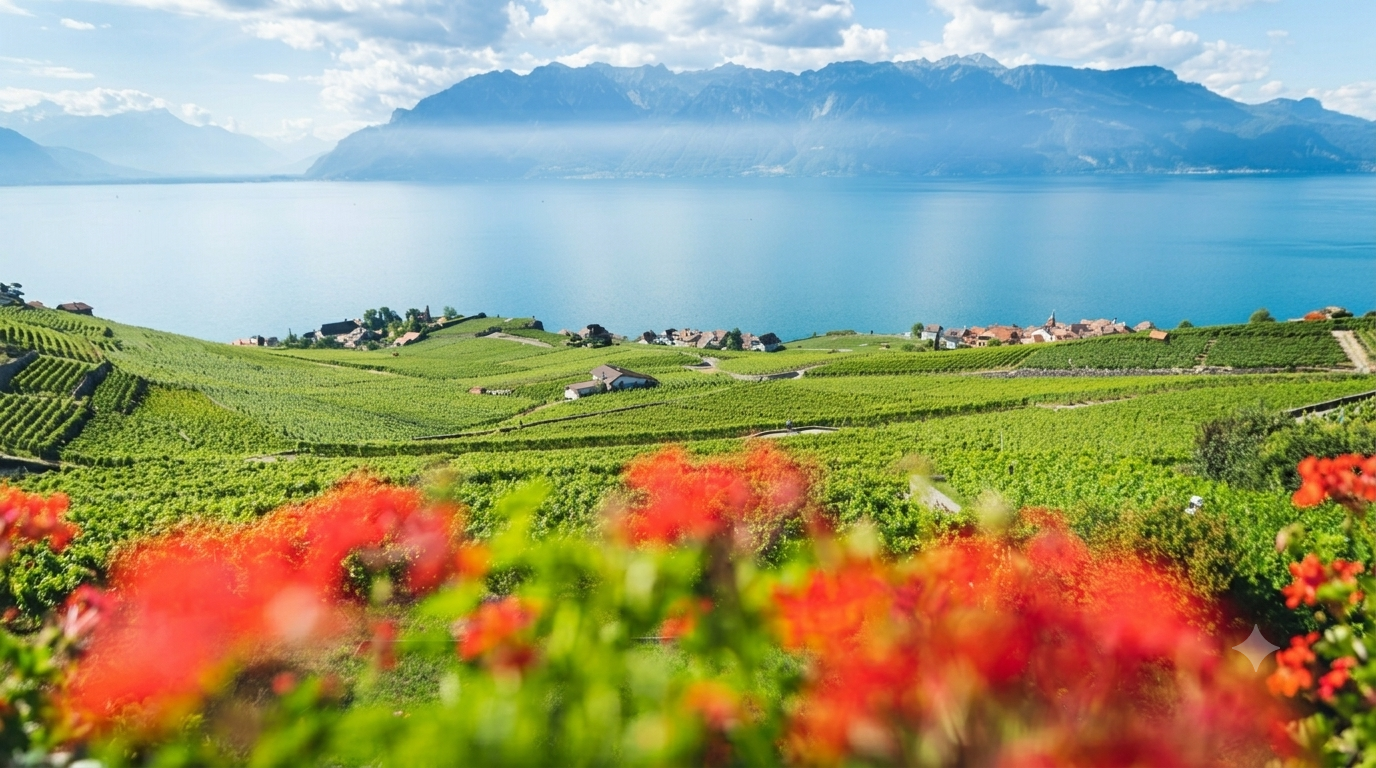
The mountains, the lake, the vineyards, the small villages and even the train journeys felt new to me. I was living in the Lavaux vineyards region at the time, surrounded by scenery that looked as though it had been carefully arranged for a tourism campaign.
Like many photographers arriving somewhere beautiful, I wanted the perfect image. I looked for clear skies, still water, snow on the mountains and light falling neatly across the vineyards.
I wanted photographs that looked unmistakably Swiss.
At that point, I was still seeing the country as a visitor, even though I had already moved there.
The Switzerland I Expected
Before I arrived, I already had a picture of Switzerland in my mind.
It was made up of mountains, lakes, chalets, red trains and villages that looked impossibly tidy. Most of what I knew came from films, travel magazines and the kinds of photographs people share after a holiday.
When I finally saw those landscapes for myself, they lived up to the image. In some ways, they were even more dramatic.
What surprised me most was how close everything seemed to be. You could travel from a lakeside town to a vineyard, a city or a mountain valley in a relatively short space of time.
The scenery was not something separate from everyday life. Mountains appeared behind supermarkets and railway stations, while vineyards ran alongside roads and residential areas.
Even so, my early photographs often tried to remove those ordinary details.
I would search for an angle without parked cars, road signs, apartment buildings or people walking through the frame. I wanted Switzerland to look timeless, almost as though nobody actually lived there.
Without realising it, I was photographing the version of the country I had expected to find.
Seeing the Same View Again
A visitor might see a landscape once. A resident sees it again and again.
That changes the way you look at it.
When you visit somewhere for a few days, the weather matters enormously. If the mountains are hidden behind clouds, it can feel as though you have missed the main event.
When you live there, you know they will still be there tomorrow.
Lake Geneva slowly became part of my normal life. I saw it on the way to work, while walking through Montreux, from train windows and on evenings when I was simply going home.
The mountains became part of the background to ordinary days.
That does not mean I stopped noticing them completely. It just meant that I no longer reached for my camera every time I saw them.
At first, I wondered whether I was becoming less observant. Perhaps familiarity was making the landscape less special.
Over time, I realised the opposite was happening. I was beginning to notice different things.
The View Was Never Really the Same
Living near the same landscape for years taught me that a familiar view is never exactly repeated.
The light changes, the weather changes and the seasons change. Even the colour of the lake can look completely different from one day to the next.
Sometimes it is deep blue. At other times, it looks silver, grey or almost green.
On a clear morning, the opposite shore can appear surprisingly close. On a misty day, the mountains disappear and the lake seems to merge into the sky.
The vineyards around Lavaux and Puidoux also changed slowly throughout the year.
As a newcomer, I mainly noticed them when they were at their most impressive. I liked the long rows of vines, the golden autumn colours and the way the terraces seemed to fall towards the water.
After living nearby, I began to notice the smaller stages.
I saw the vines before the leaves appeared, the first signs of green in spring and the subtle shift in colour before autumn fully arrived. I also became more aware of the work taking place inside the landscape.
The vineyards were not simply there to make the view more beautiful. They were working environments, shaped by weather, labour and routines that continued long after visitors had taken their photographs.
That changed the way I photographed them.
Paying Attention to Smaller Things
Once the landmarks became familiar, I began to notice what was happening around them.
I became interested in trains moving through the vineyards and in the contrast between old buildings and modern infrastructure. I noticed how a narrow village street could suddenly open onto an enormous view.
I also started paying more attention to how towns changed throughout the year.
In spring, terraces returned and people spent more time outside. In summer, the lakeside became busy, festivals appeared and public spaces filled with visitors.
Autumn felt different even before the leaves changed. The evenings became cooler, the light softened and the streets started to feel quieter.
Winter brought its own atmosphere. The mountains were sometimes clearer, but towns could feel more still and enclosed.
These were not the scenes I had moved to Switzerland expecting to photograph.
They were ordinary, but they began to feel more personal.
A railway platform with mountains behind it sometimes said more about life in Switzerland than a photograph of an empty landscape. A person carrying shopping beside the lake made the view feel lived in rather than staged.
My photographs gradually became less concerned with presenting Switzerland as perfect.
I became more interested in how people lived alongside the scenery.
When Beautiful Views Become Normal
One of the strangest things about living in Switzerland is how quickly extraordinary scenery can become part of a routine.
You can be standing at a bus stop with mountains in the distance and barely look up. You can watch a dramatic sunset while thinking about what to cook for dinner.
I have lived in several parts of French-speaking Switzerland and each place showed me a slightly different perspective.
Near the lake, the landscape feels open and connected. Trains, roads, vineyards and towns follow the shoreline, with the mountains always visible in the distance.
In the valleys, the mountains feel much closer.
Living in the alpine villages of Val-d’Illiez and Troistorrents in the Canton of Valais made me understand that mountain life is not only peaceful and picturesque. Weather can affect travel, daylight disappears earlier and a quiet setting can sometimes feel isolated.
Those experiences helped remove some of the romance I had attached to Swiss mountain villages.
That might sound negative, but it was not. The landscape became more interesting once it stopped feeling like a backdrop.
A village could be beautiful and still have practical problems. People still had to commute, shop, work, raise families and deal with bad weather.
The scenery did not disappear from daily life. It simply existed alongside everything else.
Still an Outsider, but Not a Visitor
After more than ten years, Switzerland no longer feels like a place I am simply observing from the outside.
My life here is connected to work, relationships, routines and memories. Places that once felt unfamiliar now remind me of different periods of my life.
A path beside the lake is not just somewhere to take a photograph.
It might be somewhere I walked after work, somewhere I met friends or somewhere I returned to during a difficult or important time.
At the same time, being British still affects the way I see Switzerland.
There are customs, habits and visual details that still stand out to me because I did not grow up with them. Someone born here might barely notice them.
I have come to value that position.
I am close enough to understand the context, but still distant enough to remain curious.
Photography has always involved that kind of balance. You need to be present in a place, but you also need enough distance to notice what others might pass without seeing.
Learning to Photograph Imperfect Days
The postcard version of Switzerland usually depends on good weather.
It shows blue skies, clear mountains and reflections on the lake. It does not show days of rain, construction work, fog or low clouds.
Living here means seeing all of those versions.
Some of my favourite moments now happen when the landscape does not look perfect. Fog can make a familiar place feel completely different, while rain can empty a street and change its mood.
Low clouds can hide the mountains and make the lake feel more mysterious.
Earlier in my photography, I might have waited for better conditions. Now I am more likely to accept what the day is giving me.
That shift has influenced more than my photographs.
Living somewhere means accepting that it will not always present its best side. Some days are beautiful, while others are grey, inconvenient or forgettable.
A place becomes home through all of them.
Looking More Carefully
I still understand why visitors search for the classic Swiss view.
There are days when the lake is perfectly still, the mountains are clear and the vineyards seem to glow in the evening light. Those scenes can still stop me.
The difference is that I no longer believe one photograph can explain the place.
The postcard view is real, but it is only part of the story.
Switzerland is also the train passing through the vineyards, the quiet street in winter, the festival poster at the station and the person walking home without looking at the sunset behind them.
Living here has taught me that familiarity does not have to make a place invisible.
It can make you look more carefully.
A visitor often searches for the image they came to see. A resident has the chance to notice everything that appears in between.
Perhaps that is what changed most in my photography.
I stopped trying to prove that Switzerland was beautiful. I began trying to understand what it felt like to live inside that beauty.