

The recent The Menopause Transition 2026 Report finds that atrial fibrillation prevalence rises 3.8x in US women, while heart rate variability, a validated marker of autonomic function and cardiovascular health, declines half as much as globally.
BOSTON, May 7, 2026 /PRNewswire/ — A new analysis of connected health device data from 470,000 US women finds that atrial fibrillation prevalence rises 3.8x across the menopause transition, climbing from 1.86% in early reproductive years to 7.0% by late postmenopause. Within the same dataset, heart rate variability tracked by the Withings ScanWatch 2 during sleep declines just 17%, roughly half the 33% drop observed in women worldwide.
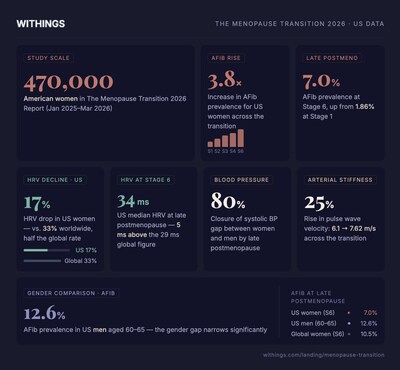
Heart Resilience in the US: Heart Rate Variability (HRV), a key marker of stress response tracked by the Withings ScanWatch 2 during sleep, declines only 17% in American women across menopause, nearly half the 33% worldwide average decline. This suggests US women maintain a higher level of cardiovascular resilience, a standout finding compared to lower US averages in sleep and activity.
“For decades, the cardiovascular impact of menopause has been underestimated. What we are now seeing is that the transition to menopause marks a meaningful shift in atrial fibrillation risk, often occurring silently and earlier than expected. This reframes menopause not only as a reproductive milestone, but as a critical window for cardiovascular awareness and earlier intervention.” – Aline Criton, Chief Regulatory and Clinical Affairs Officer, Withings
The AFib Signal: A 3.8x Rise Across the Transition
Atrial fibrillation (AFib), an irregular heart rhythm linked to stroke and heart failure, follows a steep, accelerating curve across the six stages of the menopause transition in US women. At early reproductive years, 1.86% of women with sufficient ECG recordings show AFib. By perimenopause, that figure has risen to 2.4%. It climbs to 3.4% at the menopause transition itself, then accelerates: 4.8% at early postmenopause and 7.0% at late postmenopause. The sharpest single-stage jump occurs between early menopause and late postmenopause, the window immediately following the final menstrual period.
Globally, the pattern is even steeper: worldwide women reach 10.5% AFib prevalence by late postmenopause, a 4x increase. US women’s lower absolute rate may reflect differences in population demographics, ECG recording frequency, or healthcare access rather than a meaningfully different biological risk. What is consistent across both populations is the direction and the timing: AFib risk accelerates most sharply in the postmenopause window, precisely when estrogen’s cardioprotective effects have been fully withdrawn.
For context, age-comparable men show AFib rising from 2.2% at ages 30–39 to 12.6% at ages 60–65 in the US data, a much steeper absolute trajectory, but one that has been historically well-documented. The female trajectory, by contrast, has been systematically understudied. These findings add large-scale real-world evidence to a growing body of clinical research establishing menopause as an independent cardiovascular risk event.
The HRV Paradox: Half the Global Decline
In the US dataset, women’s median HRV falls from 41 ms at Stage 1 to 34 ms at Stage 6, a loss of 7 milliseconds over the course of the transition, a 17% decline. Worldwide, the equivalent decline is from 43 ms to 29 ms, a loss of 14 ms, a 33% decline. American women lose, in absolute terms, half the HRV that women globally lose across the same period.
By late postmenopause, US women’s median HRV of 34 ms exceeds the global figure of 29 ms by 17%. The gap builds gradually but consistently from Stage 2 onwards.
US women in this dataset sleep worse than the global average at every stage, walk fewer steps, and carry a higher body fat percentage. Conventional health logic would predict steeper physiological decline. The HRV data says otherwise, suggesting that autonomic resilience may depend on variables not captured by activity or sleep metrics: medication use, access to healthcare, the genetic diversity of the US population, or environmental factors that remain to be studied.
What the Data Means for Women’s Health
The menopause transition has historically been framed as a reproductive milestone. This data reframes it as a cardiovascular event. Estrogen exerts vasodilatory effects, promotes favorable lipid profiles, and modulates autonomic tone; as estrogen declines across perimenopause and postmenopause, these protective effects erode. The AFib and HRV trajectories in this dataset document that erosion at scale. Two additional signals reinforce the picture: systolic blood pressure converges between women and men by 80% over the transition, and arterial stiffness, measured by pulse wave velocity, rises 25% from 6.1 to 7.62 m/s, changes consistent with the accelerating cardiovascular risk profile of postmenopause.
Notes to Editors
Methodology
Cross-sectional analysis, Withings connected device users, United States, January 2025–March 2026. Reproductive stages defined by age-based proxies inspired by STRAW+10 (Stages of Reproductive Aging Workshop), not clinically confirmed: Stage 1 (30–39, Early Reproductive), Stage 2 (40–44, Late Reproductive), Stage 3 (45–49, Perimenopause), Stage 4 (50–52, Menopause), Stage 5 (53–59, Early Postmenopause), Stage 6 (60–65, Late Postmenopause). Minimum data thresholds applied per metric. All findings represent between-cohort differences, not individual trajectories. Subject to Withings user selection bias, device-specific populations, and bioimpedance estimation variance. Users declaring menopause excluded due to data quality. Withings users may not represent the general US population.
About Withings
A pioneer in connected health since 2008, Withings empowers millions of users worldwide and collaborates with leading academic and clinical research institutions including Stanford and Harvard. Withings has built a world-leading ecosystem of FDA-cleared, award-winning connected health devices: smart scales with ECG, hybrid smartwatches, and blood pressure monitors, all designed to detect cardiometabolic risk early and help individuals act on it. To learn more, visit withings.com. Withings. With you. For Life.
Press Contact
Alex McKechnie
alex.mckechnie@12080group.com
475.399.4056

 View original content to download multimedia:https://www.prnewswire.com/news-releases/withings-analysis-of-470-000-us-women-reveals-afib-prevalence-increases-3-8x-and-hrv-declines-during-menopause-302764731.html
SOURCE Withings
