

SANTA MONICA, Calif., July 2, 2026 /PRNewswire/ — In a new analysis, creative studio della explains why every prestige television series has someone whose name most viewers never learn. Not the star, and not the director of any single episode, but the showrunner, the person who holds the entire season in their head at once. The showrunner decides how a throwaway line in the pilot pays off in the finale, keeps the tone steady across a dozen directors, and protects the story from the hundred small compromises that would otherwise pull it apart. When the job is done well, audiences never notice it is being done at all. The world simply feels whole.
That figure has quietly become one of the most useful ways to describe what a modern brand needs, and what many brands, stretched across an ever-expanding number of screens and platforms, no longer have.
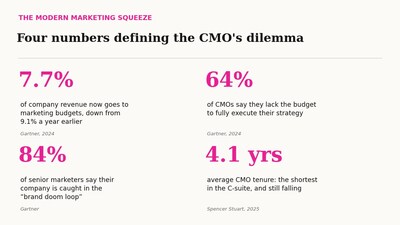
The pressure on marketing leaders has rarely been higher. Average marketing budgets fell to 7.7% of company revenue in 2024, down from 9.1% a year earlier and well below the roughly 11% that was standard before the pandemic, according to Gartner’s annual CMO Spend Survey. In the same survey, 64% of chief marketing officers said they lacked the budget to fully execute their strategy. And the person accountable for all of it does not stay long: the average CMO now lasts about 4.1 years, the shortest tenure in the C-suite, according to Spencer Stuart’s 2025 study.
Squeezed on both budget and time, marketers tend to spend on what they can measure. That instinct has a name. In a Gartner survey, 84% of senior marketing executives said their company was caught in what analysts call the “brand doom loop,” a cycle in which teams pour money into short-term, trackable performance tactics while starving the slower work of brand building, then must spend even more the following quarter to hold the same ground. The trap is expensive. Gartner’s analysis found that over-indexing on performance can cut overall revenue return on investment by as much as 40%, while rebalancing toward brand, typically directing 40% to 60% of spend to brand building, can lift it by roughly 90%.
While budgets shrink, the surface area a brand has to cover keeps growing. Brands posted an average of 9.5 times a day across social networks in 2024, and in consumer categories the figure runs far higher, according to the social-management platform Sprout Social. Audiences expect brands to keep pace: about three-quarters of social users say a company should respond within 24 hours, and Sprout’s 2025 index found that reactions to cultural moments tend to land only if they arrive within 24 to 48 hours. Miss the window, and the moment is gone.
This is the bind. One tempting response is the traditional model: deliberate, high-craft and often so slow that the moment has passed by the time the work is ready. The other is the content-mill model: fast and cheap, producing enough posts to fill a feed but rarely enough coherence to build anything. Speed without a story is noise. Story without speed is irrelevance.
The showrunner idea offers a third path, which is why the metaphor has begun to circulate among marketers. A showrunner is not simply a faster producer or a more prolific one. The role exists to hold one thing steady, the vision, while everything else moves quickly around it. Applied to a brand, that means a single owner of the story who decides what belongs and what does not, keeps the voice consistent whether the output is a six-second clip or a national campaign, and moves at the speed the culture demands precisely because the larger world is already mapped.
Notably, the industry’s own data is turning back toward coherence over raw volume. After years of chasing trends, some of the most admired brands on social, such as Duolingo and Nutter Butter, have won by committing to consistent, recognizable storylines rather than a scattershot of one-off posts. Sprout Social’s trend analysis now advises brands to post less often but more purposefully. In other words, the discipline that makes a television series memorable (continuity, a point of view, a world an audience can return to) is the same discipline that increasingly separates brands that matter from brands that merely publish.
None of this asks marketers to abandon performance marketing or to spend money they do not have. The showrunner mindset is mostly about sequencing and ownership: mapping the full range of places a brand shows up before deciding where to act, treating the gaps as the roadmap, and giving one person or team clear responsibility for keeping the whole thing coherent as it grows. It reframes “always-on” from a demand to produce endlessly into a commitment to stay considered, to keep studying the brand and the culture between big moments so the next move is never made cold.
The approach will not lengthen a CMO’s tenure or restore a pre-pandemic budget. But in what Gartner has called an “era of less,” coherence is one of the few forms of leverage still available without a bigger check. The brands that will hold attention are the ones that feel authored rather than assembled: the ones with someone, somewhere, holding the whole season in their head.
This story was produced by della, an always-on creative studio that helps brands build and maintain coherent content across every audience touchpoint. Learn more at della.one.
Sources & Methodology
Marketing budgets (7.7% of revenue, down from 9.1%) and the finding that 64% of CMOs lack budget to execute strategy: Gartner CMO Spend Survey 2024 (survey of CMOs and marketing leaders in North America and Northern/Western Europe, February–March 2024).
The “brand doom loop” (84% of senior marketers) and the performance-vs-brand ROI figures: Gartner research, reported by MediaPost.
Average CMO tenure of 4.1 years: Spencer Stuart CMO Tenure Study 2025.
Posting frequency (9.5 posts/day), 24-hour response expectations, the 24–48 hour window for cultural reactions, and guidance to post less but more purposefully: Sprout Social (2025 Sprout Social Index and trend analysis).
 View original content to download multimedia:https://www.prnewswire.com/news-releases/why-the-smartest-brands-now-run-like-television-shows-302817100.html
SOURCE della
