

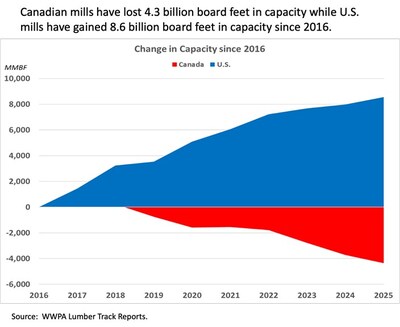
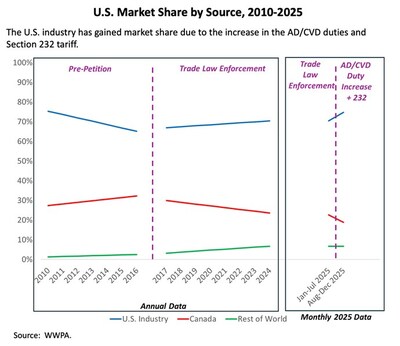
WASHINGTON, May 12, 2026 /PRNewswire/ — Effective U.S. trade law enforcement coupled with President Trump’s highly effective Section 232 tariff measures have forced a reduction in Canada’s U.S. market share to more natural levels not seen in half a century – currently at 19 percent, down from 34 percent in 2016. Simultaneously, ample softwood lumber supply for the U.S. market has been sustained as the U.S. softwood lumber industry responded to the border measures by making investments to add 8.6 billion board feet of softwood lumber production capacity since 2016. Through these investments, U.S. lumber manufacturing facilities have produced an additional 36 billion board feet of lumber since 2016. That is more U.S. lumber produced by U.S. workers to build U.S. homes while supporting 1.3 million U.S. jobs.
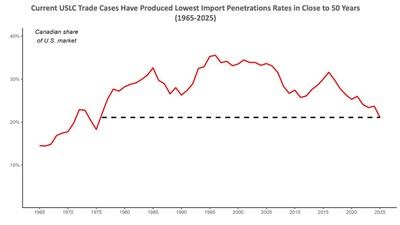
While Canada’s reprehensible response to U.S. trade law enforcement is to double down on its unfair trade practices, having announced billions of dollars in new subsidies since August 2025 alone, the U.S. Lumber Coalition will continue to work aggressively to bring about a further reduction of Canada’s massive, unsustainable, and harmful excess lumber capacity that is at the core of Canada’s dumping and unfair trade practices.
“The U.S. Lumber Coalition strongly applauds President Trump’s firm commitment to enforcing our trade laws and using all tools available to address the problem of Canada’s massive excess softwood lumber production that is at the center of Canada’s harmful unfair trade practices. It is essential to address Canada’s continued unfair trade practices in order to further boost our domestic softwood lumber production capacity,” stated Zoltan van Heyningen, Executive Director of the U.S. Lumber Coalition.
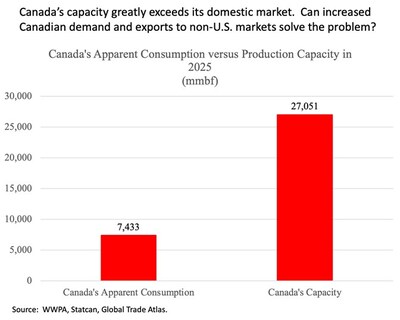
“Canada consumes around 7.5 billion board feet of softwood lumber annually but maintains an annual production capacity of 27 billion board feet. Almost 90 percent of their softwood lumber exports depends on the U.S. market, causing Canadian softwood lumber producers to dump their product into the U.S. market in a desperate attempt to maintain their lumber production and U.S. market share. Those same Canadian lumber producers then depend on massive subsidies in order to make their entire scheme work while causing U.S. job losses,” added van Heyningen.
“Canadian dependency on the U.S. market coupled with their massive excess lumber capacity has been suppressing and harming U.S. softwood lumber producers and U.S. workers for far too long. President Trump has the power to address Canada’s massive and harmful excess softwood lumber capacity by adjusting border measures until Canada reduces its excess lumber capacity to levels where it can no longer engage in unfair trade. After reducing Canada’s market share from 34 to 19 percent, we are about halfway to achieving the Canadian market share levels needed in the United States to eliminate Canadian unfair trade practices,” stated van Heyningen.
Canada is doubling down on unfair trade, announcing billions of dollars in new softwood lumber subsidies since August 2025 alone in direct response to the United States’ enforcement of antidumping and countervailing duty laws and President Trump’s Section 232 tariff measures. Canadian provinces are now calling for even more subsidies in order to maintain the country’s massive and unneeded excess softwood lumber capacity, which is designed to maintain Canadian jobs at the direct expense of U.S. jobs and the stable supply of U.S.-made softwood lumber.
- British Columbia’s Prime Minister and Forest Minister are calling for billions of dollars in additional softwood lumber subsidies, stating that the federal government should “double or even triple the more than $2 billion in support … provided to the sector nationwide since last August,” urging the Canadian federal government to show up “with their chequebooks” to hand out more Canadian taxpayer funded subsidies.
- Ontario’s provincial government has released its latest plan for maintaining unneeded and harmful excess lumber production capacity, which depends on the U.S. market to absorb 97 percent of the province’s exports. Ontario’s plan is specifically designed to “protect forestry businesses and workers from the impact of … duties and tariffs” in order to “keep critical mills operating by working with the federal government to get their support through provincial funding programs to mitigate the impact of tariffs and duties in the sector.” Their stated main concern (which echoes all of Canada’s concern) is that duties and tariffs make it “more likely to replace Ontario-made forest products with domestic [i.e., Made in USA] alternatives.”
- New Brunswick is boasting that, through new and expanded multi-million dollar subsidy schemes, “New Brunswick was the only place in Canada that’s kept all its big lumber mills open – all 18 of them – with none of them cutting shifts.” The provincial government has explained that it achieved this result by “helping the industry’s entire value chain – including spinoff businesses that use saw dust, wood chips, pulp and the like – by making enough wood available on Crown land and keeping royalty fees on timber low.”
“It is outrageous that Canada is openly boasting about its plan to actively subvert the proper and appropriate U.S. application of its trade laws, mainly antidumping and countervailing duties, and President Trump’s goal of increasing U.S. softwood lumber production through his Section 232 tariff measures,” stated van Heyningen.
“Thankfully, President Trump has the power and the tools to address Canada’s outrageous unfair trade behavior. Canada has built its own deep dependency on the U.S. market with its commitment to maintaining the excess capacity that drives its unfair trade behavior, and, ironically, it is this self-imposed dependency that may provide the solution to Canada’s unfair trade practices, as it gives President Trump full control over the level of Canada’s excess lumber capacity through appropriate U.S. border measures. The President can exert that control by simply increasing tariff collections at the U.S. border which are paid directly by Canadian softwood lumber producers who own the importers of record,” concluded van Heyningen.
NEW CANADIAN SUBSIDIES ANNOUNCED SINCE AUGUST 2025
Canada’s Unfair Trade is Threatening America’s Rural Main Street Economy
Canada has a long and well-documented history of subsidizing its forest industry in order to maintain its unfair trading practices, with several dozen *programs investigated and countervailed since 2016. Since August 2025, Canada announced an estimated C$2.1 billion in forestry-specific subsidies designed to counter and undermine U.S. trade law enforcement. In total, Canada’s forest industry has access to new or augmented government support programs amounting to more than C$9.9 billion dollars.
Federal: C$1.7 billion in Forestry Subsidies and making available more than C$9.152 billion in total aid
- Softwood Lumber Guarantee Program: In August 2025, the GOC announced a plan to deliver $700 million in loan guarantees through the Business Development Bank of Canada to “help companies confront immediate pressures facing the softwood lumber sector, which will give the sector needed liquidity to maintain and restructure, if necessary, their operations.” (https://natural-resources.canada.ca/forest-forestry/forest-industry-trade/measures-transform-canada-softwood-lumber-industry)
In November 2025, the GOC announced an additional $500 million in funding for this program, resulting in a total of $1.2 billion in loan guarantees available to Canadian softwood lumber producers. (https://globalnews.ca/news/11543966/liberals-loans-lumber-producers-foreign-steel/)
In January 2026, GreenFirst Forest Products Inc. announced that it received a $30 million loan under this program “to support liquidity and ongoing operations amid continued market volatility in the North American lumber sector.” The loan will give the company “financial flexibility and provide{} additional runway as the Company continues to navigate challenging lumber market conditions while executing on its operational and strategic priorities.” (https://greenfirst.ca/2026/01/greenfirst-secures-30-million-term-loan-under-federal-softwood-lumber-program/)
In March 2026, Conifex Timber Inc. announced that one of its subsidiaries received a $19 million loan under this program “to repay a bridge advance from Conifex’s existing senior secured timber lender.” (https://www.globenewswire.com/news-release/2026/03/05/3249802/0/en/Conifex-Announces-Secured-Term-Loan-with-BDC-under-the-Softwood-Lumber-Guarantee-Program.html) - NRCan Forest Industry Transformation Programs: In August 2025, the GOC announced that it would commit $500 million beginning in FY26 to “supercharge product and market diversification and make the industry more competitive globally.” This funding will be provided through programs including the Forest Innovation Program, Investments in Forest Industry Transformation, Green Construction Through Wood, the Indigenous Forestry Initiation, Expanding Market Opportunities program, and Forest Systems Information and Technology Enhancement program. (https://natural-resources.canada.ca/forest-forestry/forest-industry-trade/measures-transform-canada…)
- Reskilling Package: In September 2025, the GOC announced a new reskilling package created to train 50,000 workers to invest in Canadians through the federal government’s Labour Market Development Agreements with provinces and territories. The GOC pledged an additional $450 million over the next three years to train employees, including “mid-career, long-tenured workers affected by U.S. tariffs and global market shifts.” (https://www.pm.gc.ca/en/news/backgrounders/2025/09/05/prime-minister-carney-launches-new-measures-protect-build-and)
- Workforce Alliances and Sectoral Workforce Innovation Fund: In September 2025, the government announced it would invest $382 million over the next five years to “invest in projects tailored to local job markets to help businesses recruit and retain the workforce they need.” (https://www.pm.gc.ca/en/news/backgrounders/2025/09/05/prime-minister-carney-launches-new-measures-protect-build-and)
- Workforce Innovation Fund: In September 2025, the government announced it would provide $50 million to fund “projects that help businesses in key sectors and regions recruit and retain the workforce they need.” (https://www.pm.gc.ca/en/news/backgrounders/2025/09/05/prime-minister-carney-launches-new-measures-protect-build-and)
- Strategic Response Fund: In September 2025, the GOC launched this new program to support “economic resilience” for “strategic sectors disproportionately exposed to U.S. tariffs and global trade risks.” “Now, the federal government is introducing and revamping SIF into a new $5 billion fund, the Strategic Response Fund (SRF).” (https://ised-isde.canada.ca/site/ised/en/programs-and-initiatives/strategic-response-fund) ( https://funding.ryan.com/blog/government-funding/from-sif-to-srf-understanding-canadas-new-5b-strategic-response-fund/)
- Immediate Liquidity Relief: In September 2025, the Business Development Bank of Canada announced that it would offer loans of $2 – $5 million for SMEs impacted by tariffs. The Bank will also offer “{f}lexibilities to the Large Enterprise Tariff Loan Facility, including lower interest rates and longer maturities.” (https://www.pm.gc.ca/en/news/backgrounders/2025/09/05/prime-minister-carney-launches-new-measures-protect-build-and)
- Regional Tariff Response Initiative: This program was created earlier this year in March, and in September 2025, the GOC announced that it would significantly increase allocated funds from $450 million to $1 billion over the next three years to support businesses (particularly SMEs) directly or indirectly impacted by U.S. tariffs. (https://www.pm.gc.ca/en/news/backgrounders/2025/09/05/prime-minister-carney-launches-new-measures-protect-build-and)
- New Buy Canadian Policy: By November 2025, the GOC pledged to prioritize Canadian suppliers in federal spending and have amended its procurement requirements to require all federal agencies and Crown corporations to follow the Buy Canada Policy. The Policy includes Canadian softwood lumber. (https://www.pm.gc.ca/en/news/backgrounders/2025/09/05/prime-minister-carney-launches-new-measures-protect-build-and; https://www.pm.gc.ca/en/news/news-releases/2025/11/26/prime-minister-carney-announces-new-measures-protect-and-transform?utm_source=chatgpt.com)
- Lumber Freight Subsidies: In November 2025, the GOC announced that it would begin subsidizing the cost to move Canadian lumber domestically by paying half the cost of transporting lumber within Canada directly to freight companies. (https://globalnews.ca/news/11543966/liberals-loans-lumber-producers-foreign-steel/)
- Workforce Tariff Response: In February 2026, the federal government invested $570 million over the next three years in the Workforce Tariff Response program. This funding was provided with the goal of “help{ing} up to 66,000 workers in vulnerable industries,” including softwood lumber workers. (https://www.canada.ca/en/employment-social-development/programs/training-agreements/workforce-tariff-response.html#h2.3)
- Investments in Forest Industry Transformation: In March 2026, the Parliamentary Secretary to the Minister of Energy and Natural Resources, announced a federal investment of over $4.4 million for ten projects that will strengthen the forest sector in Alberta and Manitoba. Among the projects funded, Western Archrib Enterprises is receiving $2.3 million through the IFIT program to fund a 160,000 square foot timber plant in Surgeon, Alberta. (https://www.canada.ca/en/natural-resources-canada/news/2026/03/government-of-canada-invests-in-strengthening-the-prairies-forest-sector0.html)
Alberta:
- Regional Tariff Response Initiative for the Prairie Provinces (AB, MB, SK): In September 2025, the Prairies Economic Development Canada initiated a program in response to the Regional Tariff Response Initiative strategy announced by the GOC earlier that month. This program is being administered to “protect Canadian businesses and workers from the impacts of tariffs.” (https://www.canada.ca/en/prairies-economic-development/services/funding/regional-tariff-response-initiative.html)
- Government of Alberta Forestry and Parks: In May 2026, the Alberta government announced a program aimed at “reduc{ing} financial pressures{,} remov{ing} barriers that may delay decision-making and improv{ing} wildfire outcomes through faster coordinated response.” The program offers up to $125,000 in wildlife response support to municipalities within the province. (https://globalnews.ca/news/11829043/alberta-2026-wildfire-season-preparation/#:~:text=The%20program%20offers%20municipalities%20up,explained%20at%20a%20press%20conference.)
British Columbia: C$202.6 million for the forestry industry specifically (including 170 million estimated for stumpage deferral), and more than C$612.5 million in total
- BC Manufacturing Jobs Fund: In September 2025, the GBC announced $2.5 million in funding for nine wood-product manufacturing businesses to plan or complete capital projects. (https://news.gov.bc.ca/releases/2025FOR0039-000907)
- Regional Tariff Response Initiative: In October 2025, as part of the GOC’s strategy announced in September, the GBC launched this program to “defend Canadian jobs, industries, and supply chains” and to “protect Canadian businesses and workers from the impact of tariffs.” Approved projects may receive $200,000 to $10 million in funding. Proposals from businesses in certain sectors, including forestry, will be prioritized. (https://www.canada.ca/en/pacific-economic-development/services/funding/regional-tariff-response-initiative.html)
- Pacific Economic Development Canada: In March 2026, Pacific Economic Development Canada (PEDC) announced more than $13 million for 10 Regional Tariff Response Initiative projects across B.C.’s Southern Interior. Most of the funds are tied to BC’s forestry sector to “help businesses impacted by tariffs by helping them boost productivity, cut costs, build more resilient supply chains, reach new markets and protect jobs.” (After deducting the non-forestry funds, the total subsidy is worth $9,123,015.) (https://www.woodworkingnetwork.com/news/canadian-news/bc-forestry-related-concerns-receive-tariff-relief-funding)
- Canada-British Columbia Workforce Tariff Response: In January 2026, the GBC amended its Labor Market Development Agreement (LMDA) with the federal government, in which the GOC will “provide a time-limited, targeted funding increased under the Canada–British Columbia LMDA through the Canada–British Columbia Workforce Tariff Response for fiscal years 2025-2026 to 2027-2028, with reporting requirements extending to 2029-2030, to support workers and employers in steel, softwood lumber, and other directly and indirectly tariff-affected sectors.” (https://www.bclaws.gov.bc.ca/civix/document/id/oic/oic_cur/0002_2026).
In March 2026, it was announced that the GOC and GBC are investing $70.4 million in this program over the next three years. The program will “support more than 8,000 workers in industries affected by global tariffs.” (https://www.hcamag.com/ca/specialization/leadership/704million-plan-bc-employers-get-funding-to-retrain-tariffhit-workers/567710) - Stumpage Payment Deferral Program: In February 2026, as part of the Budget 2026 announcement, the GBC announced that “{t}o provide immediate cash flow relief to tenure holders, the Province is introducing a temporary Stumpage Payment Deferral Program, effective from Jan. 1, 2026, until Nov. 30, 2026.” (https://news.gov.bc.ca/releases/2026FIN0003-000158; https://www.bcbudget.gov.bc.ca/2026/pdf/2026_Budget_and_Fiscal_Plan.pdf)
- Northern Development Initiative Trust: In February 2026, as part of the Budget 2026 announcement, the GBC allocated $20 million in funding to the Trust “to help employers and workers in both the forestry and steel industries.” (https://news.gov.bc.ca/releases/2026FIN0003-000158; https://www.bcbudget.gov.bc.ca/2026/pdf/2026_Budget_and_Fiscal_Plan.pdf)
- Forestry Service Providers Compensation Fund: In February 2026, as part of the Budget 2026 announcement, the GBC provided $5 million in funding to this program “to provide relief to contractors left unpaid for their services in the event of a tenure holder’s insolvency.” (https://news.gov.bc.ca/releases/2026FIN0003-000158; https://www.bcbudget.gov.bc.ca/2026/pdf/2026_Budget_and_Fiscal_Plan.pdf)
- BC Manufacturing and Processing Investment Tax Credit: In February 2026, as part of the Budget 2026 announcement, “a new temporary manufacturing and processing investment tax credit for the manufacturing sector” will be introduced and will “provide a 15 per cent refundable tax credit for qualifying corporations.” (https://news.gov.bc.ca/releases/2026FIN0003-000158; https://www.bcbudget.gov.bc.ca/2026/pdf/2026_Budget_and_Fiscal_Plan.pdf)
- BC Strategic Investment Fund: In February 2026, the GBC announced that it is working on passing legislation that will provide $400 million in funding to incentivize large private-sector projects, including in the forestry industry. (https://news.gov.bc.ca/releases/2026JEG0013-000188; https://www.bcbudget.gov.bc.ca/2026/pdf/2026_Budget_and_Fiscal_Plan.pdf)
- FireSmart Community Funding and Supports Program: In February 2026, as part of the Budget 2026 announcement, the GBC announced that it will be investing an additional $15 million in the FireSmart Community Funding and Supports program to “reduce{} wildfire risk by funding planning, education, co-ordination and fuel-management activities on publicly owned and Crown land.” (https://news.gov.bc.ca/releases/2026FOR0004-000228)
Manitoba: C$18.2 million for the forestry industry specifically
- Canada-Manitoba Workforce Tariff Response: In March 2026, the GOM announced that through the Workforce Tariff Response program, it would be receiving $18.2 million over the next three years to “retrain displaced workers for high demand sectors, provide upskilling opportunities for current employees and support businesses as they adapt to new products and markets.” The fund will benefit workers in industries affected by tariffs, such as steel and lumber. (https://www.gov.mb.ca/asset_library/en/budget2026/budget2026.pdf)
- Tax Deferrals for Businesses Impacted by Tariffs and Wildfires: In its Budget 2026 announcement in March, the GOM stated that would be providing “targeted tax deferrals for businesses impacted by tariffs and wildfires” to “give{} businesses flexibility to manage shot-term financial pressures.” (https://www.gov.mb.ca/asset_library/en/budget2026/budget2026.pdf)
New Brunswick: C$1 million for the forestry industry specifically
- Investment in Atlantic Canada’s Forestry Sector: In February 2026, Natural Resource Canada announced $2.8 million in funding for seven forestry projects in New Brunswick and Nova Scotia. Nearly $1 million in funding will support four projects across New Brunswick. These investments aim to “transform the forestry industry . . . in the face of global trade pressures” in conjunction with the broader national effort. (https://www.canada.ca/en/natural-resources-canada/news/2026/02/government-of-canada-invests-in-atlantic-canadas-forest-sector.html) (https://springboardatlantic.ca/canada-invests-2-8m-in-atlantic-canadas-forest-sector-to-drive-innovation-and-sustainability/)
Ontario: C$148 million for the forestry industry specifically
- Ontario Forest Access Roads Program:
- In September 2025, the GOO announced a $20 million increase in funding for Provincial Forest Access Roads program (already countervailed). (https://www.northernontariobusiness.com/industry-news/forestry/ottawa-must-turn-talk-into-action-to-save-forestry-says-ontario-associate-minister-11270907)
- In April 2026, the GOO announced an updated “forest sector roadmap” which included updated investment figures for Ontario’s Forest Access Roads Funding Program. It announced that the GOO has invested $458 million (since 2018) “to maintain and develop essential forest roads,” “which are essential infrastructure in forestry-dependent communities.” (https://www.ontario.ca/page/ontarios-forest-sector-roadmap#section-3)
- Ontario Sawmill Chip Support Program: In September 2025, the GOO announced a $10 million increase in funding in 2025-2026 for Ontario Sawmill Chip Support program to help sawmills find “new, innovative markets for their wood chips.” (https://www.northernontariobusiness.com/industry-news/forestry/ottawa-must-turn-talk-into-action-to-save-forestry-says-ontario-associate-minister-11270907) (https://www.ontario.ca/page/roadmap-protecting-ontarios-forest-sector)
- Investments in Steel and Softwood Lumber Industries: In September 2025, through the Federal Economic Development Agency for Northern Ontario, the government announced “a series of investments to strengthen the economy across Northern Ontario.” These initiatives will support “workers and businesses most affected by tariffs and trade disruptions.” (https://www.woodworkingnetwork.com/news/canadian-news/ontario-economic-agency-announces-investments-steel-and-softwood-industries)
- Regional Tariff Response Initiative in Southern Ontario: In October 2025, as part of the GOC’s strategy announced in September, the GOO launched the RTRI to help businesses across all sectors “overcome trade disruptions” caused by tariffs. Businesses can request funding ranging from $125,000 to $10 million. (https://feddev-ontario.canada.ca/en/funding-southern-ontario/regional-tariff-response-initiative-southern-ontario)
- Northern Ontario Heritage Fund Corporation (NOHFC) Funding: In February 2026, the GOO announced that it was investing $1 million through the NOHFC “to help Kirkland Lake Forest Products install advanced manufacturing equipment at its mill in Kenogami.” This funding aims to “increase {the mill’s} competitiveness, boost productivity and protect the forestry sector,” and further explains that this funding comes “{a}t a time when U.S. tariffs are putting a strain on norther industries.” (https://nohfc.ca/ontario-investing-1-million-to-upgrade-lumber-mill-in-kenogami/)
- Canada-Ontario Workforce Tariff Response: In March 2026, the GOO announced that it would be investing $228.8 million over the next three years, with support from the federal government, to help “up to 27,000 workers across the province retrain, upgrade their skills and stay competitive in key sectors of the economy, including softwood lumber, steel and automotive manufacturing.” (https://news.ontario.ca/en/release/1007136/ontario-and-canada-investing-more-than-228-million-to-protect-workers-and-key-industries)
- Forest Sector Investment and Innovation Program (FSIIP):
- In March 2026, the GOO announced that it will invest over $72 million in the FSIIP program “to help Ontario forestry companies adopt innovative technologies to stay competitive in global markets.” The significant boost in funding is part of the government’s plan to “protect workers and businesses from tariffs and economic uncertainty.” (https://budget.ontario.ca/2026/chapter-1a.html#:~:text=Investing%20in%20Ontario’s%20Forest%20Biomass%20Program&text=Across%20its%20four%20streams%2C%20this,the%20program’s%20launch%20in%202023)
- In April 2026, the GOO announced an updated “forest sector roadmap” which included updated investment figures for the FSIIP. The GOO now expects to invest $98 million for 27 projects “to enhance forest sector productivity and efficiency.” (https://www.ontario.ca/page/ontarios-forest-sector-roadmap#section-3) (https://www.ontario.ca/page/roadmap-protecting-ontarios-forest-sector)
- Funding Announced for New Engineered Wood Products Plant: In April 2026, the Parliamentary Secretary to the Minister of Energy and Natural Resources announced it will invest $4 million in the construction of a new wood products plant in Ontario. The Secretary emphasized the “need for predictable fibre access” as well as the government’s goal to provide certainty to Canada’s forest products sector amidst increased U.S. duties adding that “the federal government is actively working to combat these tariffs and to continue to seek fair market access to the U.S. for Canadian producers.” (https://www.canadianbiomassmagazine.ca/funding-announced-for-new-engineered-wood-products-plant-during-cofi-convention/)
- Forest Biomass Program: In April 2026, the GOO announced an updated “forest sector roadmap” which included updated investment figures for Ontario’s Forest Biomass Program. The GOO announced that it has committed $50 million to over 55 research, innovation, and modernization initiatives to “increase long-term wood use, promote forest sector innovation, and support sustainable forest management by maximizing the value for wood.” (https://www.ontario.ca/page/ontarios-forest-sector-roadmap#section-3) The application website includes new application deadlines for April and October 2026. (https://www.ontario.ca/page/forest-biomass-program)
- Northern Ontario Resource Development Support (NORDS) Funding: In April 2026, the Ontario government announced an additional investment of $15 million “in ongoing annual funding” through the NORDS fund “to help northern municipalities continue to improve local infrastructure and support responsible economic growth in the North.” The program has invested $75 million since 2021, and in 2025-2026, 144 municipalities received funding, which included funding for the forestry industry. (https://news.ontario.ca/en/release/1007358/ontario-investing-15-million-to-protect-and-support-northern-communities)
- Forthcoming Strategy to Protect Ontario Forest Sector: In April 2026, the Ontario government announced a new provincial “road map” which encompasses a ten-year plan intended to “give the sector a competitive edge,” specifically by modernizing mills, cutting red tape, and attracting investment to the industry. While the announcement did not include any specific investment at this time, the Associate Minister of Forestry and Forest Products stated that the province can “[e]xpect to see more ‘exciting’ funding opportunities in the months ahead.” (https://www.northernontariobusiness.com/industry-news/forestry/ford-government-pitches-new-strategy-to-protect-diversify-ontario-forest-sector-12206003) (https://news.ontario.ca/en/release/1007371/ontario-launches-roadmap-to-protect-forest-sector-workers-and-businesses)
Quebec: C$80 million for the forestry sector specifically
- Strategic Response Fund: In January 2026, the federal government announced that it was providing $7.5 million through the Strategic Response Fund to “help Kap Paper Inc. complete a Front End Engineering Design (FEED) study to support a pivot in its operations toward growth markets.” (https://www.canada.ca/en/innovation-science-economic-development/news/2026/01/government-of-canada-announces-funding-to-support-regional-sawmills-and-employment-in-northeast-ontario.html)
- Annual Royalty Fee for Sawmills Dropped: In February 2026, the GOQ announced that it will “hold a ‘mini-reform’ of the province’s forest regime to provide relief for sawmills and other businesses pressured by cumulative U.S. tariffs.” In doing so, the GOQ stated that it would “abolish the annual sawmill royalty – a move {the government} estimates will return roughly $20 million a year to the sector.” (https://www.cbc.ca/news/canada/montreal/quebec-forest-regime-mini-reform-9.7104351)
- Working Capital Assistance Program: In March 2026, the GOQ announced that its Budget 2026-207 Plan includes providing $60 million “for a working capital assistance program for wood processing businesses that will undertake investment projects to support their growth and adaptation.” The GOQ further explains that this “{g}overnment support for wood processing businesses, particularly sawmills, which are an essential link for the forestry sector, will benefit all workers in the sector.” (https://www.finances.gouv.qc.ca/Budget_and_update/budget/documents/Budget2627_BudgetPlan.pdf#page=44)
- Temporary Holiday from Contributions to Health Services Fund: In March 2026, the GOQ announced that its Budget 2026-207 Plan that, effective January 1, 2026, the agricultural, fishing, and forestry sectors will benefit from a two-year temporary holiday from contributions to the province’s Health Services Fund, which “enables them to free up liquidity that is essential for their ongoing operations, and helps keep workers employed.” It appears that this exemption will result in $129 million savings for the forestry sector. (https://www.finances.gouv.qc.ca/Budget_and_update/budget/documents/Budget2627_BudgetPlan.pdf#page=44)
- Canada-Quebec Workforce Tariff Response: In April 2026, the GOC and GOQ signed an agreement that will provide Quebec with $122.5 million in funding over the next three years through the Workforce Tariff Response program “to support workers and businesses within the softwood lumber steel and other directly and indirectly tariff-affected industries through a period of significant economic adjustment.” (https://www.canada.ca/en/employment-social-development/news/2026/04/governments-of-canada-and-quebec-reach-1225-million-agreement-to-support-tariff-impacted-workers.html)
Saskatchewan: C$15.6 million
- Canada-Saskatchewan Workforce Tariff Response: In March 2026, the federal government and GOS announced that in partnership through the Workforce Tariff Response program, $15.6 million over the next three years would be invested in Saskatchewan to “support workers and employers in the steel and softwood lumber sectors, as well as other directly and indirectly tariff-affected sectors.” The fund is expected to “support up to 1,800 workers” in the province to “build new skills and seize emerging opportunities.” (https://www.canada.ca/en/employment-social-development/news/2026/03/governments-of-canada-and-saskatchewan-partner-to-protect-tariff-impacted-workers-and-strengthen-the-workforce0.html)
CONTACT: Zoltan van Heyningen
zoltan@uslumbercoalition.org | 202-805-9133

 View original content to download multimedia:https://www.prnewswire.com/news-releases/us-lumber-coalition-us-trade-law-enforcement-and-president-trumps-section-232-tariffs-are-an-unparalleled-success-in-boosting-domestic-production-and-cutting-unfair-trade-302770008.html
SOURCE The U.S. Lumber Coalition
