

“Confined culture system” developed at Cincinnati Children’s opens doors for faster, wider use of lab-grown human tissues in disease studies and drug development
Key Takeaways
- New system produces human gut organoids about twice as fast as prior methods.
- Gut organoids with functioning nerve cells can be grown to much larger sizes.
- Platform works for small intestine, colon, and stomach organoids, improving scalability and reproducibility.
- This advance could expand organoid use in disease research, drug safety testing, and eventually regenerative medicine.
CINCINNATI, May 22, 2026 /PRNewswire/ — Researchers at Cincinnati Children’s report a breakthrough manufacturing advance that makes human gut organoids faster to produce, easier to scale and more biologically complete.
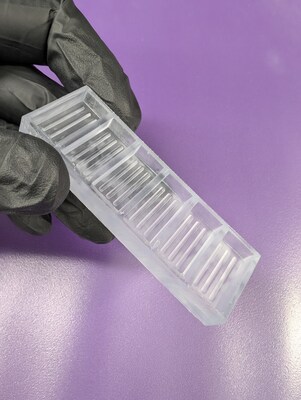
In a study published May 22, 2026, in Nature Biomedical Engineering, the team describes a “confined culture system” that generates human small intestine, colon and stomach organoids in about half the time required by prior methods while also enabling the tissues to develop their own functional nerve cells.
The approach uses 3D-printed tray-like scaffolds with narrow grooves that physically confine multiple organoid spheroids, encouraging them to fuse, elongate and mature into tubular tissues. By day 14, the constructs had reached a stage that previously took 28 days, according to the authors.
In rodent transplantation studies, all implanted tissues engrafted, and the researchers report generating up to 8 centimeters of functional small-intestine tissue compared with about 1 centimeter using earlier protocols.
The study, led by Holly Poling, PhD, with senior author Maxime Mahe, PhD, and 17 colleagues at Cincinnati Children’s and Nantes Université, addresses a central bottleneck in organoid science: how to move from small lab models to larger, reproducible tissues with features needed for translational work. The authors report that the platform produced centimeter-scale organoids nearly 10 times larger than those generated by standard methods.
Importantly, the organoids developed an enteric nervous system without the added complexity of separately introducing nerve cells. That result could matter for disease modeling because neuromuscular function is essential to how the gastrointestinal tract moves, senses and responds to injury and drugs. The study shows that the transplanted tissues have neuromuscular activity resembling native human tissue.
“By reaching transplantation maturity twice as fast and developing their own functional nerves, these organoids demonstrate how engineering principles can drive biological innovation,” Poling says. “Our confined culture system is more than a production method; it’s a scalable, flexible platform for building complex human tissues.”
Mahe says the system offers a more defined growth environment that allows the cells’ intrinsic self-organization to generate tissue structures that more closely resemble the human gastrointestinal tract. This work also reflects a broader trend in regenerative medicine: combining stem-cell biology with engineered culture environments to improve reproducibility, scale and function.
Jim Wells, PhD, a study co-author and chief scientific director at CuSTOM says the new technology overcomes key barriers to scale and function in organoid research and biomanufacturing.
“This platform’s simplicity, reproducibility, and versatility make it accessible for widespread adoption,” Wells says. “In addition, the emergence of a self-organized nervous system within these organoids is particularly important for further studies of neurodevelopmental disorders.”
The work remains preclinical, and the authors caution that full-sized replacement organs are still out of reach. But the advance could strengthen three fast-moving areas of research: disease modeling, drug safety testing and regenerative medicine. By producing larger and more standardized tissues more quickly, the method may help labs generate organoids that are more practical for mechanistic studies and for evaluating transplantation strategies.
Michael Helmrath, MD, co-director of CuSTOM and a co-author, said additional development will be needed before CCS-derived tissues are ready for human trials. If the approach continues to perform well, organoid-based therapies could eventually reduce the need for full-organ transplantation in some gastrointestinal disorders.
“We believe such tissues, once transplanted, would further grow and multiply as part of the patient’s own organ to restore functions,” he says.
About the study
In addition to Poling, Mahe, Wells and Helmrath, the paper includes co-authors from Cincinnati Children’s, Inserm and Nantes Université. Funding came from the National Institute of Diabetes and Digestive and Kidney Diseases and the Agence Nationale de la Recherche.
Publication Information
|
Original title: |
Large-scale and innervated functional human gut tissues for transplantation via transient spheroid confinement |
|
Published in: |
Nature Biomedical Engineering |
|
Publish date: |
May 22, 2026 |

 View original content to download multimedia:https://www.prnewswire.com/news-releases/scientists-unlock-scalable-production-of-human-gut-organoids-with-functional-nerves-302779665.html
SOURCE Cincinnati Children’s Hospital Medical Center
