

Phase 2 bench-scale testwork program demonstrates a compelling opportunity for a more simplified and selective processing pathway to produce a variety of high purity caesium based chemical products from Shaakichiuwaanaan’s pollucite concentrate.
MONTREAL, Sept. 22, 2026 /PRNewswire/ — September 23, 2026 – Sydney, Australia
Highlights
- The Company continues to work with Koch Technology Solutions (“KTS”), part of Koch Inc., in evaluating downstream processing pathways to produce value-added caesium chemical products.
- The results of the recent Phase 2 testwork program have successfully demonstrated a pathway for the production of multiple caesium products.
- KTS’s proprietary technology could significantly simplify and lower the costs of producing a wide variety of high-purity caesium products from pollucite.
- Follow-up testwork program is now being designed and is anticipated to be expanded to include a complete bench-scale proof-of-concept with production of marketable samples.
- Pollucite concentrate generated from the ongoing BerryPick Program will underpin the next phase of the testwork with KTS (see press release, September 8, 2026).
- The Company continues to advance discussions with strategic caesium players downstream, including deepening its existing relationship with KTS, for future chemical processing opportunities.
- Caesium and tantalum are anticipated co-products at Shaakichiuwaanaan, with the potential for future revenue to be credited against the cost of lithium production. A Preliminary Economic Assessment, targeted for Q4 2026, will provide the first economic evaluation of the caesium credit.
PMET Resources Inc. (the “Company” or “PMET”) (TSX: PMET) (ASX: PMT) (OTCQX: PMETF) (FSE: R9GA) is pleased to report results from its Phase 2 bench-scale caesium testwork program completed by Koch Technology Solutions (“KTS”), part of Koch Inc., on pollucite concentrate from its Shaakichiuwaanaan Project, host to the world’s largest pollucite-hosted caesium pegmatite Mineral Resource and one of the world’s largest lithium pegmatite Mineral Reserves1.
The Company continues to evaluate downstream opportunities beyond pollucite concentrate production at site to potential “value-added” caesium chemicals, produced with strategic partners with chemical expertise to maximize value from its globally significant caesium resource. The KTS proprietary process offers an attractive and compelling process route for caesium extraction from pollucite concentrate into marketable chemical products, potentially capturing more economic value from the caesium resource. This program further develops the potential process pathway.
Koch Technology Solutions Caesium Extraction Testwork Program
The program was carried out under a testwork arrangement with KTS, announced on April 15, 2026. KTS, part of Koch Inc., one of the largest privately held companies in the world, develops, commercializes, and licenses critical minerals extraction technologies. The arrangement with KTS allows the Company’s testwork program to leverage demonstrated capabilities in engineering, development, and commercialization of critical minerals extraction technologies.
Following completion of Phase 1 (see news release dated July 12, 2026), the Phase 2 bench-scale program advanced by KTS was designed to assess the application of their proprietary flowsheet technology that uses highly selective media. The approach targets simplification of the existing, more conventional caesium recovery methodology by significantly increasing selectivity for caesium, which would allow for much of the impurity removal stage(s) to be bypassed. In contrast, existing approaches require additional stages to obtain the desired caesium product purity. If successful, the approach using KTS’s proprietary flowsheet offers an opportunity to significantly lower the cost of recovery into a final high-purity caesium product.
The results of the recent bench-scale testwork have successfully established the potential for a wide variety of caesium end-products to be produced by the KTS process, demonstrating high selectivity for caesium and a much-reduced impurity profile. Further work is required to validate the process through to marketable samples; however, the confirmation of high selectivity for caesium using Shaakichiuwaanaan pollucite concentrate, is a significant milestone.
|
____________________________ |
|
1 Consolidated MRE (CV5 + CV13 pegmatites) totals 108.0 Mt at 1.40% Li2O and 166 ppm Ta2O5 (Indicated), and 33.4 Mt at 1.33% Li2O and 155 ppm Ta2O5 (Inferred), at an Li2O cut-off grade of 0.40% (open-pit), 0.60% (underground CV5), and 0.70% (underground CV13). A grade constraint of 0.50% Cs2O was used to model the Rigel and Vega caesium zones, contained entirely within CV13, with a MRE of 0.69 Mt at 4.40% Cs2O (Indicated), and 1.70 Mt at 2.40% Cs2O (Inferred). The Effective Date is June 20, 2025. Mineral Resources are not Mineral Reserves as they do not have demonstrated economic viability. Mineral Resources are inclusive of Mineral Reserves. Project hosts a Probable Mineral Reserve of 84.3 Mt at 1.26% Li2O at the CV5 Pegmatite with a cut-off grade is 0.40% Li2O (open-pit) and 0.70% Li2O (underground). The Effective Date is September 11, 2025. See Feasibility Study news release dated October 20, 2025. |
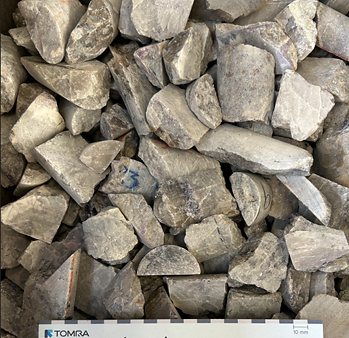
The pollucite concentrate (~6 kg) used as feed for the KTS caesium extraction testwork program was produced by X-Ray Transmission (XRT) ore sorting of drill core material from the Vega Caesium Zone at the CV13 Pegmatite (see news release dated October 9, 2025) and assayed 12% Cs2O (Figure 1)
Next Steps
A follow-up testwork program is now being designed and is anticipated to comprise a complete bench-scale proof-of-concept for the processing of pollucite concentrate from Shaakichiuwaanaan through to gram quantities of marketable caesium products (e.g., caesium formate, caesium carbonate), as well as an initial assessment of OPEX-CAPEX. This program will utilize a larger quantity of concentrate, which is currently targeted to be produced from the ongoing BerryPick Program (see news release dated September 8, 2026).
The pollucite sample collection methodology undertaken in the BerryPick program is designed to produce >500 kg to potentially >1 tonne of pollucite concentrate to support ongoing development and downstream caesium chemical testwork initiatives. This includes future chemical testwork programs with Koch Technology Solutions, as well as with others as the Company furthers its engagement with strategic partners in the caesium industry downstream (see news release dated April 15, 2026).
In addition to being one of the largest lithium-tantalum pegmatite Mineral Resources2 and lithium pegmatite Mineral Reserves3 globally, the Property also hosts the world’s largest in-situ pollucite-hosted caesium pegmatite Mineral Resource, comprising 0.69 Mt at 4.40% Cs2O (Indicated) and 1.70 Mt at 2.40% Cs2O (Inferred). The CV13 Pegmatite, host to the caesium Mineral Resource, is located <3 km along trend from the CV5 Pegmatite, which is situated approximately 13 km south of the regional Trans-Taiga Road and powerline infrastructure corridor, and is accessible year-round by road.
About Caesium
Mineral deposits of pollucite-hosted caesium are very rare globally and represent the most fractionated component of LCT pegmatite systems, which are effectively the only known primary economic source of caesium supply. Economic deposits of caesium pegmatite are typically on a smaller scale of <10 kt to 350 kt in size compared to deposits of lithium pegmatite that typically range in the millions of tonnes in size (<10 Mt to over 100 Mt).
The market for caesium compounds and metals is niche and largely opaque because it is not publicly traded like copper or gold, but rather through private bi-lateral and term contracts. Further, product prices vary depending on their contained caesium form, purity, and end-product use. As an example, caesium carbonate (Cs2CO3≥99%) as an indicative spot price currently trades at around US$250/kg (excluding VAT, Price Sourcing – Shanghai Metal Markets (SMM)4
Caesium is currently supply constrained, with only limited sources supplying the global market. A discovery at the size, grade, and scale of Shaakichiuwaanaan has the potential to be a primary source of supply for global markets over the long-term. This includes existing applications for caesium in oil/gas drilling, medical imaging, emissions reduction, atomic clocks and precision GPS navigation, as well as new and potentially growing applications in the terrestrial solar panel industry. Caesium has been found to play a vital role in significantly improving next generation solar panel efficiency, stability, and life span. Additionally, the use of caesium in lithium-ion batteries to improve performance is actively being explored through use as an additive in certain cathode, anode, and electrolyte chemistries.
|
____________________________ |
|
2 Consolidated MRE (CV5 + CV13 pegmatites) totals 108.0 Mt at 1.40% Li2O and 166 ppm Ta2O5 (Indicated), and 33.4 Mt at 1.33% Li2O and 155 ppm Ta2O5 (Inferred), at an Li2O cut-off grade of 0.40% (open-pit), 0.60% (underground CV5), and 0.70% (underground CV13). A grade constraint of 0.50% Cs2O was used to model the Rigel and Vega caesium zones, contained entirely within CV13, with a MRE of 0.69 Mt at 4.40% Cs2O (Indicated), and 1.70 Mt at 2.40% Cs2O (Inferred). The Effective Date is June 20, 2025. Mineral Resources are not Mineral Reserves as they do not have demonstrated economic viability. Mineral Resources are inclusive of Mineral Reserves. |
|
3 Probable Mineral Reserve of 84.3 Mt at 1.26% Li2O at the CV5 Pegmatite with a cut-off grade is 0.40% Li2O (open-pit) and 0.70% Li2O (underground). Underground development and open-pit marginal tonnage containing material above 0.37% Li2O are also included in the statement. The Effective Date is September 11, 2025. See Feasibility Study news release dated October 20, 2025. |
|
4 SSM publishes an indicative spot price for 99% caesium carbonate in China. Given the small and relatively opaque nature of the global caesium market and the limited observable transaction volumes traded on SMM, the SMM should be regarded as an indicative market reference rather than a directly achievable price for PMET’s potential caesium products. |
About Koch Technology Solutions.
Koch Technology Solutions (KTS) is a global leader in technology development, commercialization and licensing. KTS works with owners, developers, and investors in the process, manufacturing and critical minerals sectors to solve complex technical and investment challenges before large capital is committed, helping clients make confident decisions from early concept through EPC-ready design. With a global network and rich history of domain experience and expertise, KTS gains additional strength from its position within Koch Engineered Solutions (KES). This backing enhances our ability to partner with companies developing chemical process technologies, create attractive licensing solutions for commercial deployment, and bring the next generation of technologies to the market.
For further information, please contact us at info@pmet.ca or by calling +1 (604) 279-8709, or visit www.pmet.ca. Please also refer to the Company’s continuous disclosure filings, available under its profile at www.sedarplus.ca and www.asx.com.au, for available exploration data.
Qualified/Competent Person
The technical and scientific information in this news release that relates to the Mineral Resource Estimate, exploration, and metallurgical results for the Company’s properties is based on, and fairly represents, information compiled by Mr. Darren L. Smith, M.Sc., P.Geo., who is a Qualified Person as defined by National Instrument 43-101 – Standards of Disclosure for Mineral Projects (“NI 43-101”), and member in good standing with the Ordre des Géologues du Québec (Geologist Permit number 01968), and with the Association of Professional Engineers and Geoscientists of Alberta (member number 87868). Mr. Smith has reviewed and approved the related technical information in this news release.
Mr. Smith is an Executive and Vice President of Exploration for PMET Resources Inc. and holds common shares, Restricted Share Units (RSUs), Performance Share Units (PSUs), and options in the Company.
Mr. Smith has sufficient experience, which is relevant to the style of mineralization, type of deposit under consideration, and to the activities being undertaken to qualify as a Competent Person as described by the Australasian Code for Reporting of Exploration Results, Mineral Resources and Ore Reserves (the JORC Code). Mr. Smith consents to the inclusion in this news release of the matters based on his information in the form and context in which it appears.
The information in this news release that relates to the Mineral Reserve Estimate and Feasibility Study is based on, and fairly represents, information compiled by Mr. Frédéric Mercier-Langevin, Ing. M.Sc., who is a Qualified Person as defined by NI 43-101, and member in good standing with the Ordre des Ingénieurs du Québec. Mr. Mercier-Langevin has reviewed and approved the related technical information in this news release.
Mr. Mercier-Langevin is the Chief Operating and Development Officer for PMET Resources Inc. and holds common shares, RSUs, PSUs, and options in the Company.
About PMET Resources Inc.
PMET Resources Inc. is a pegmatite critical mineral exploration and development company focused on advancing its district-scale 100%-owned Shaakichiuwaanaan Property located in the Eeyou Istchee James Bay region of Quebec, Canada, which is accessible year-round by all-season road and proximal to regional hydro-power infrastructure.
In late 2025, the Company announced a positive lithium-only Feasibility Study on the CV5 Pegmatite for the Shaakichiuwaanaan Property and declared a maiden Mineral Reserve of 84.3 Mt at 1.26% Li2O (Probable)5. The study outlines the potential for a competitive and globally significant high-grade lithium project targeting up to ~800 ktpa spodumene concentrate using a simple Dense Media Separation (“DMS”) only process flowsheet. Further, the results highlight Shaakichiuwaanaan as a potential North American critical mineral powerhouse with significant opportunity for tantalum and caesium in addition to lithium.
The Project hosts a Consolidated Mineral Resource6 totalling 108.0 Mt at 1.40% Li2O and 166 ppm Ta2O5 (Indicated) and 33.4 Mt at 1.33% Li2O and 155 ppm Ta2O5 (Inferred), and ranks as a top ten lithium pegmatite globally in size. Additionally, the Project hosts the world’s largest pollucite-hosted caesium pegmatite Mineral Resource at the Rigel and Vega zones with 0.69 Mt at 4.40% Cs2O (Indicated), and 1.70 Mt at 2.40% Cs2O (Inferred).
|
____________________________ |
||
|
5 See Feasibility Study news release dated October 20, 2025. Probable Mineral Reserve cut-off grade is 0.40% Li2O (open-pit) and 0.70% Li2O (underground). Underground development and open-pit marginal tonnage containing material above 0.37% Li2O are also included in the statement. Effective Date of September 11, 2025. |
||
|
6 Consolidated MRE (CV5 + CV13 pegmatites) is reported at an Li2O cut-off grade of 0.40% (open-pit), 0.60% (underground CV5), and 0.70% (underground CV13). A grade constraint of 0.50% Cs2O was used to model the Rigel and Vega caesium zones, contained entirely within CV13. The Effective Date is June 20, 2025. Mineral Resources are not Mineral Reserves as they do not have demonstrated economic viability. Mineral Resources are inclusive of Mineral Reserves. |
This news release has been approved by
“KEN BRINSDEN”
Kenneth Brinsden, President, CEO, & Managing Director
Disclaimer for Forward-Looking Information
This news release contains “forward-looking statements” and “forward-looking information” within the meaning of applicable securities laws.
All statements, other than statements of present or historical facts, are forward-looking statements. Forward-looking statements involve known and unknown risks, uncertainties and assumptions and accordingly, actual results could differ materially from those expressed or implied in such statements. You are hence cautioned not to place undue reliance on forward-looking statements. Forward-looking statements are typically identified by words or expressions such as “opportunity”, “continues”, “potential”, “follow-up”, “anticipated”, “expanded”, “advance, “future”, “targeted”, “maximize”, “marketable”, “targets”, “if successful”, “further”, “milestone”, “next steps”, “initial”, “designed to”, “growing”, “being explored” or variations of such words or expressions and phrases or statements that certain actions, events or results “may”, “could”, “would”, “might” or “will” be taken, occur or be achieved.
Forward-looking statements include, but are not limited to, statements concerning the ability to produce value-added caesium chemical products, the ability of Koch’s proprietary technology to significantly simplify and lower the costs of producing a wide variety of high-purity caesium products from pollucite, the ability to design a follow-up expanded testwork program to include a complete bench-scale proof-of-concept program with production of marketable samples, the ability to continue to advance discussions with strategic caesium players downstream, including deepening for future chemical processing opportunities, the timing of the PEA and the ability of Koch’s proprietary technology to significantly lower the cost of recovery into a final high-purity caesium product.
Forward-looking statements are based upon certain assumptions and other important factors that, if untrue, could cause actual results to be materially different from future results expressed or implied by such statements. There can be no assurance that forward-looking statements will prove to be accurate. Key assumptions upon which the Company’s forward-looking information is based include, without limitation, the ability of developing Koch’s technology, to obtain the required financing to bring the project to development, the ability to make discoveries, the potential of each of tantalum, lithium and caesium , that proposed exploration work on the Property and the results therefrom will continue as expected, the accuracy of reserve and resource estimates, the classification of resources and the assumptions on which the reserve and resource estimates are based, long-term demand for lithium (spodumene), tantalum (tantalite), and caesium (pollucite) supply, and that exploration and development results continue to support management’s current plans for the Property’s development.
Forward-looking statements are also subject to risks and uncertainties facing the Company’s business, any of which could have a material adverse effect on the Company’s business, financial condition, results of operations and growth prospects. Readers should review the detailed risk discussion in the Company’s most recent Annual Information Form filed on SEDAR+, for a fuller understanding of the risks and uncertainties that affect the Company’s business and operations.
Although the Company believes its expectations are based upon reasonable assumptions and has attempted to identify important factors that could cause actual actions, events or results to differ materially from those described in forward-looking statements, there may be other factors that cause actions, events or results not to be as anticipated, estimated or intended. There can be no assurance that forward-looking information will prove to be accurate. If any of the risks or uncertainties mentioned above, which are not exhaustive, materialize, actual results may vary materially from those anticipated in the forward-looking statements.
The forward-looking statements contained herein are made only as of the date hereof. The Company disclaims any intention or obligation to update or revise any forward-looking statements, whether as a result of new information, future events or otherwise, except to the extent required by applicable law. The Company qualifies all of its forward-looking statements by these cautionary statements.
Competent Person Statement (ASX Listing Rules)
The information in this news release that relates to the Feasibility Study (“FS”) for the Shaakichiuwaanaan Project, which was first reported by the Company in a market announcement titled “PMET Resources Delivers Positive CV5 Lithium-Only Feasibility Study for its Large-Scale Shaakichiuwaanaan Project” dated October 20, 2025 (Montreal time) is available on the Company’s website at www.pmet.ca, on SEDAR+ at www.sedarplus.ca and on the ASX website at www.asx.com.au. The production target from the Feasibility Study referred to in this news release was reported by the Company in accordance with ASX Listing Rule 5.16 on the date of the original announcement. The Company confirms that, as of the date of this news release, all material assumptions and technical parameters underpinning the production target in the original announcement continue to apply and have not materially changed.
The Mineral Resource and Mineral Reserve Estimates in this release were first reported by the Company in accordance with ASX Listing Rules 5.8 and 5.9 in market announcements titled “World’s Largest Pollucite-Hosted Caesium Pegmatite Deposit” dated July 20, 2025 (Montreal time) and “PMET Resources Delivers Positive CV5 Lithium-Only Feasibility Study for its Large-Scale Shaakichiuwaanaan Project” dated October 20, 2025 (Montreal time) and are available on the Company’s website at www.pmet.ca, on SEDAR+ at www.sedarplus.ca and on the ASX website at www.asx.com.au. The Company confirms that, as of the date of this news release, it is not aware of any new information or data verified by the competent person that materially affects the information included in the relevant announcement and that all material assumptions and technical parameters underpinning the estimates in the relevant announcement continue to apply and have not materially changed. The Company confirms that, as at the date of this announcement, the form and context in which the competent person’s findings are presented have not been materially modified from the original market announcement.
Appendix 1 – JORC Code 2012 Table 1 (ASX Listing Rule 5.8.2)
Section 1 – Sampling Techniques and Data
|
Criteria |
JORC Code explanation |
Commentary |
|
Sampling techniques |
|
|
|
Drilling techniques |
|
|
|
Drill sample recovery |
|
|
|
Logging |
|
|
|
Sub-sampling techniques and sample preparation |
|
|
|
Quality of assay data and laboratory tests |
|
|
|
Verification of sampling and assaying |
|
|
|
Location of data points |
|
|
|
Data spacing and distribution |
|
|
|
Orientation of data in relation to geological structure |
|
|
|
Sample security |
|
|
|
Audits or reviews |
|
|
Section 2 – Reporting of Exploration Results
|
Criteria |
JORC Code explanation |
Commentary |
|
Mineral tenement and land tenure status |
|
|
|
Exploration done by other parties |
|
|
|
Geology |
|
|
|
Drill hole Information |
|
|
|
Data aggregation methods |
|
|
|
Relationship between mineralization widths and intercept lengths |
|
|
|
Diagrams |
|
|
|
Balanced reporting |
|
|
|
Other substantive exploration data |
|
|
|
Further work |
|
|
 View original content to download multimedia:https://www.prnewswire.com/news-releases/pmet-successfully-completes-phase-2-caesium-testwork-program-with-koch-technology-solutions-302886568.html
SOURCE PMET Resources Inc.
