

TORONTO, September 8, 2026 /PRNewswire/ — IsoEnergy Ltd. (“IsoEnergy”, or the “Company”) (NYSE American: ISOU); (TSX: ISO) is pleased to report on radioactive zones intersected in summer drilling along the Hurricane South Trend on the Larocque East project (the “Project“), which hosts the high-grade Hurricane deposit (“Hurricane” or the “Deposit“). Summer drilling at Larocque East totaled 10,159 m in 26 holes, for a year-to-date total of 16,963 m in 43 drill holes (Figure 1). The summer program was expanded from a planned 8,000 m, 20-hole program to follow up on encouraging winter and early summer results (see news release dated July 8, 2026). Highlights of drill core radiometric results and uranium geochemistry from the winter holes were reported on April 7, 2026 and May 12, 2026, respectively. All samples from the summer program have been submitted to SRC Geoanalytical Laboratories and results will be reported when available.
Hurricane hosts a current Mineral Resource of 48.6 Mlb U3O8 at 34.5% U3O8 Indicated, and 2.7 Mlb U3O8 at 2.2% U3O8 Inferred (see “Qualified Person Statement” below). The Project benefits from excellent infrastructure, located approximately 40 km northwest of the McClean Lake mill, and features relatively shallow mineralization at approximately 325 m depth, supporting efficient exploration and future development optionality. The Deposit is located on the Larocque Trend, an important regional structure that also hosts other notable high-grade occurrences including those on Cameco and Orano’s Dawn Lake joint venture.
Highlights
- The summer drill program successfully intersected widespread, strongly elevated radioactivity over a strike length of 600 m along the South Trend.
- 18 of the 26 holes returned intervals at or above the cut-off of >350 cps threshold over 0.5 m, 13 holes returned 1,000 cps or greater, and three holes returned over 35,000 cps including the strongest radioactivity drilled to date on the South Trend. All radioactivity results reported herein are measured on drill core as total counts per second (“cps”) with three readings averaged over each 0.5 m sample interval.
- Drill holes LE26-250 and LE26-273 intersected strongly elevated radioactivity on the L fault zone along strike east and west of mineralization previously reported in winter drill hole LE26-248 (4.21% U3O8 over 3.5 m, including up to 11.6% U3O8 over 1.0 m).
- LE26-250, drilled 75 m east of LE26-248 and outside the existing Hurricane footprint, intersected 11,075 cps over 3.5 m, including 43,160 cps over 0.5 m (see news release dated July 8, 2026).
- LE26-273, drilled 11 m west of LE26-248, intersected 14,135 cps over 3.0 m, including 36,292 cps over 1.0 m. Like LE26-248, LE6-273 was drilled in the southernmost portion of the Deposit footprint in an area previously interpreted as within the low-grade shell. This interpretation will be revisited once uranium geochemistry results are available.
- Drill hole LE26-254 intersected strongly elevated radioactivity, on strike west of previously reported mineralization in winter drill hole LE26-234 (1.00% U3O8 over 1.5 m, including up to 2.75% U3O8 over 0.5 m), on the interpreted L fault zone 510 m east of the existing Hurricane footprint.
- LE26-254, drilled 28 m west of LE26-234, intersected 10,110 cps over 2.0 m, including 35,900 cps over 0.5 m.
Table. 1 Selected Radioactivity Highlights, 2026 Summer Program, Larocque East Project1,2,3,4
|
Hole ID |
Target Area |
From (m) |
To (m) |
Length (m) |
Radioactivity (cps) |
|
LE26-250 |
West L Fault |
341.0 |
344.5 |
3.5 |
11,075 |
|
Includes |
342.0 |
342.5 |
0.5 |
43,160 |
|
|
LE26-254 |
East L Fault |
331.5 |
333.5 |
2.0 |
10,110 |
|
Includes |
333.0 |
333.5 |
0.5 |
35,900 |
|
|
LE26-273 |
West L Fault |
328.0 |
331.0 |
3.0 |
14,135 |
|
Includes |
328.5 |
329.5 |
1.0 |
36,292 |
|
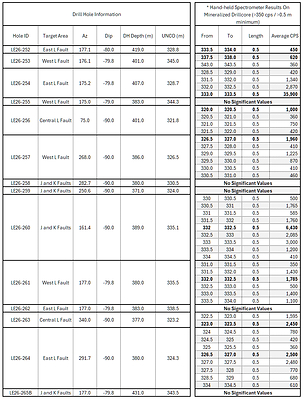
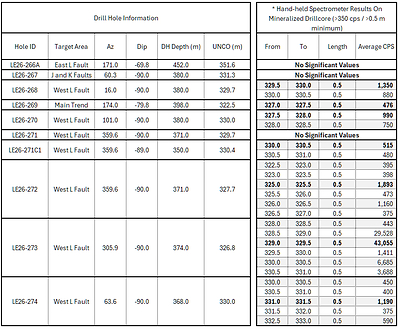
1. See Table 2 for a listing of individual 0.5 m mineralized intervals defined as intervals over which average RS-125 handheld spectrometer readings on drill core exceeded 350 cps. |
|
|
2. Radioactivity is total gamma from drill core measured with an RS-125 hand-held spectrometer. |
|
|
3. Individual 0.5 m interval cps values reported throughout this press release are averages of three readings taken over the 0.5 m interval. |
|
|
4. Measurements of total gamma cps on drill core are an indication of uranium content but may not correlate with uranium chemical assays. |
Dan Brisbin, Vice President Exploration, commented, “Our Larocque project team and contractor partners safely completed an expanded summer program despite a temporary demobilization in June due to a nearby wildfire. Nearly half of the holes drilled in 2026 intersected elevated radioactivity. Multiple holes along the Hurricane South Trend returned strongly elevated results, including thirteen of the twenty-six summer holes at 1,000 cps or greater, both inside the Hurricane deposit footprint and along strike of it. Geochemical results are pending, and those assays, together with the geological observations from drill core, will shape how we define targets for 2027.”
Hurricane Resource Expansion Drilling
Summer drilling focused on expansion of the Hurricane mineral resource. Twenty-six holes were completed to target, with three holes abandoned in sandstone, for a total of 10,159 m. This was expanded from a planned 8,000 m in twenty holes based on early encouraging results. Aside from one hole (LE26-269) that tested the eastern extension of the Hurricane Main trend (Figure 1), all drilling was focused on the Hurricane South Trend. Within the South Trend, six holes tested J and K faults, and seventeen holes tested L fault. LE26-273 tested the L fault within the existing Deposit footprint and extended the zone of elevated radioactivity associated with mineralization intersected by winter hole LE26-248 (4.21% U3O8 over 3.5 m, including up to 11.6% U3O8 over 1.0 m) 11 m to the west.
The Hurricane area geological interpretation is being updated based on information gathered from the forty-three drill holes completed in 2026. Geochemical results will be added when received, and new and existing information integrated during evaluation of 2027 drill target potential.
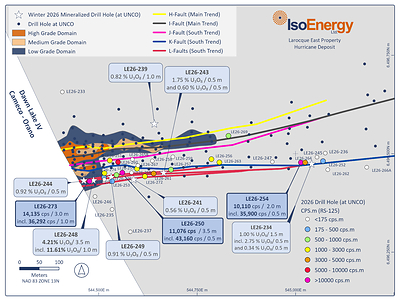
The east-striking structures at Hurricane are grouped into three trends: the North Trend (not shown, minor unnamed faults north of the deposit), Main Trend (H and I faults), and the South Trend (J, K and L faults).
West L Fault Target
LE26-255, LE26-257, LE26-261, LE26-268, and LE26-270 to LE26-274 were drilled to follow up on strong radioactivity intersected in drill holes LE26-248 and LE26-250 on the L-fault zone. A strong illite spectral mineralogy signature dominates through the lower 150 m of sandstone with the lowermost five metres of sandstone dominantly characterized by a mix of illite and chlorite in most holes.
The West L fault target area was a major focus of the summer drill program. Many of the drill holes tested the optimal target position, specifically LE26-250, LE26-261, LE26-268, and LE26-273, where the results correlate with strongly elevated radioactivity. The Company is advancing a geological model for the area to assess its potential based on the winter and summer results.
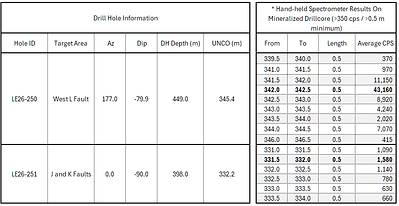
LE26-250, drilled 75 m east of LE26-248, intersected 11,075 cps over 3.5 m, including 43,160 cps over 0.5 m (see news release dated July 8, 2026). This hole was drilled outside of the existing Hurricane footprint.
LE26-253 intersected elevated radioactivity averaging 620 cps over 0.5 m between 337.5 and 338.0 m, about 3 m above the unconformity (see news release dated July 8, 2026). The sandstone column is dominantly illitic.
LE26-255 was drilled 30 m east of LE26-250 to test for mineralization The sandstone below 130 m is strongly illitic, transitioning to a mixture of chlorite and illite within 5.0 m of the unconformity. The sandstone is strongly altered with clay and limonite centred on fault zones 70 m above the unconformity. A 0.5 m graphitic fault was intersected 20.0 m below the unconformity.
LE26-257 was completed to test mineralization between LE26-243 and LE22-115A. It intersected an average of 686 cps from 326.5 to 331.0 m, including 1,960 cps and 1,225 cps over 0.5 m intervals. The sandstone column is dominantly illitic below 100 m. Limonite, chlorite, and secondary hematite alteration are associated with the mineralized interval.
LE26-261 intersected 1,094 cps over 3.0 m from 331.0 to 334.0 m. The sandstone column is dominantly illitic starting 215 m above the unconformity.
LE26-268 intersected 1,115 cps over 1.0 m from 329.5 to 330.5 m. The sandstone is dominantly illitic, apart from a 35 m interval in the lower sandstone.
LE26-270 intersected 870 cps over 1.0 m from 327.5 to 328.5 m. The sandstone column is dominantly illitic throughout, with the basal 2.0 m consisting of a mixture of illite, chlorite, and sudoite.
LE26-271 didn’t intersect elevated radioactivity, but significant alteration and structure were intersected starting 100 m above the unconformity. Fault-controlled hydrothermal hematite was intersected at 287 m and 302 m. Spectral clay analysis shows strong illite starting 200 m above the unconformity.
LE26-271C1 intersected 498 cps over 1.0 m from 330.0 to 331.0 m. The sandstone is dominantly illitic with mix of illite and chlorite from 5 m above the unconformity
LE26-272 intersected elevated radioactivity over 3.0 m from 322.5 to 327.0 m, featuring a maximum of 1,893 cps over 0.5 m. Illite dominated sandstone starts 200 m above the unconformity.
LE26-273 intersected elevated radiometry from 328.0 to 331.0 m, averaging 14,135 cps, including 36,292 cps over a 1.0 m interval.
LE26-274 intersected elevated radioactivity from 330.0 to 333.0 m, with a peak reading of 1,190 cps over a 0.5 m interval.
J and K Fault Targets
Drillholes LE26-251, LE26-258, LE26-259, LE26-260, LE26-265B, and LE26-267 targeted interpreted J fault at the unconformity.
LE26-251 was drilled to test the J fault at the unconformity (see news release dated July 8, 2026). The sandstone column is illitic starting 180 m above the unconformity. The lower sandstone is moderately bleached, with frequent desilicified and argillized intervals centered on structure. Elevated radioactivity up to 1,580 cps was intersected over 0.5 m from 331.5 m to 332.0 m within an interval with strong sooty pyrite alteration, and within a broader interval straddling the unconformity which averages 980 cps over 3.0 m from 331.0 m to 334.0 m. The hole intersected the unconformity 6 m north of optimal target. LE26-258 was drilled to test the K fault at the unconformity. The hole intersected a strongly graphitic and pyritic unit that hosts multiple faults. The unconformity intercept in this hole is interpreted to be 10 metres south of the optimal target.
LE26-259 was drilled to test the K fault at the unconformity. The hole did not intersect elevated radioactivity. A strongly graphitic fault is present 26 m below unconformity. The drill hole is interpreted to be 4 m north of the optimal target.
LE26-260 was drilled to test J fault at the unconformity. The hole intersected 1,971 cps over 4.5 m from 330.0 to 334.5 m, including 6,430 cps over 0.5 m. The sandstone column is illitic starting 200 m above the unconformity. The lower sandstone is strongly bleached, with frequent desilicified and argillized intervals centred on structure. Basement core includes strongly graphitic intervals and multiple graphitic faults. The hole tested optimal target.
LE26-265B was drilled to test J fault at the unconformity. The hole intersected strong alteration and structure in the basal sandstone and basement; however, no significant radioactivity was intersected. The drill hole is interpreted to 6 m north of the optimal target.
LE26-267 was drilled to test K fault at the unconformity. The hole didn’t intersect significant radioactivity. Moderate bleaching and interstitial clay were intersected through the lower sandstone. The drill hole intersected moderately illitic sandstones from 150 m to 15 m above the unconformity. The basal 10 m of sandstone is a mix of chlorite and illite. Basement core hosts multiple graphitic faults and the most significant is a 30 cm graphitic fault, intersected 13 m below the unconformity. The drill hole is interpreted to be 5 m north of the optimal target.
Central L Fault Target
Drill holes LE26-256 and LE26-263 were completed to extend mineralization intersected in LE21-101 and LE25-207. LE26-256 intersected an average of 633 cps over 2 m. A 16 m wide zone of broken core with moderate alteration was intersected 25.8 m above the unconformity, including strong hydrothermal hematite over a 2 m interval at 294 m. Basement core intersected a metre-scale cataclastic fault 39 m below the unconformity. This basement fault was targeted with drill hole LE26-263, which intersected 2,023 cps over 1.0 m from 322.5 to 323.5 m. The middle and basal sandstone is dominantly illitic in both drillholes. A significantly altered fault zone consisting of clay, limonite, and desilicification was intersected 19 m above the unconformity in drill hole LE26-263. Sooty pyrite and chloritization are associated with the mineralized zone, and basement core is strongly chloritized down to 10 m below the unconformity. Potential remains open along east for 150 m.
Hurricane Main Trend Target
LE26-269 was drilled on the Hurricane Main Trend 40 m east of the existing Deposit footprint. It intersected a maximum of 476 cps over a 0.5 m sample. The sandstone column 170 m above the unconformity is strongly illitic, while the basal 5 m above the unconformity contains a mixture of chlorite and kaolinite.
Southeast L Fault Target
Drill holes LE26-252, LE26-254, LE26-262, LE26-264, LE26-266A were completed on the eastern portion of interpreted L-fault.
LE26-252 was drilled 30 m east of mineralized winter hole LE26-234 (see news release dated July 8, 2026). The sandstone is moderately bleached below 143.5 m. Multiple fault zones with strong quartz dissolution and white clay were intersected through lower sandstone. The basement rocks are moderately to strongly clay altered to 337.7 m, with weakly elevated radioactivity intersected within the clay altered zone (450 cps over 0.5 m from 333.5 m to 334.0 m). The drill hole is interpreted to be 8 m north of the optimal target.
LE26-254 was drilled 27 m west of mineralized drill hole LE26-234. It intersected elevated radioactivity immediately below the unconformity from 331.5 to 333.5 m averaging 10,110 cps, including 35,900 cps over 0.5 m. The lower sandstone unit is strongly altered, with bleaching, argillization, and desilicification centered on fault zones, alongside patches of hydrothermal hematite immediately above the mineralized zone. The sandstone column below 140 m has a dominantly illitic signature. Basement core down to 40 m below the unconformity is moderately altered with pervasive, mineral-controlled clay and chloritization. Radioactivity was intersected in the basement rather than at the unconformity, but the drill hole is interpreted to have tested the optimal target position, with the basement structure intersected immediately below the unconformity.
LE26-262 was drilled up-dip of a basement structure intersected in drill hole LE26-252. It intersected strong alteration consisting of bleaching, desilicification, and argillization roughly 100 m above the unconformity. The basal sandstone includes secondary hematitization centred on a fault and strong clay replacement. The hole is interpreted to have intersected the unconformity 12 m south of the optimal target.
LE26-264 was drilled to test the L fault at the unconformity between LE26-234 and LE26-254. The hole intersected 849 cps over 5.0 m from 324.0 to 329.0 m, including 2,490 cps over 1.0 m from 326.5 to 327.5 m. Middle and basal sandstone is dominantly illitic. Strongly bleached core begins 50 m above the unconformity, featuring patches of limonite and argillized intervals. A secondary radioactive interval in the basement (610 cps at 334.5 m) is associated with secondary hematite and clay. The hole achieved its objective, intersecting elevated radioactivity at the unconformity.
LE26-266A was planned as step-out hole approximately 140 m east of mineralization intersected in previous holes to test the extent of the alteration footprint in the eastern part of the L-fault. It intersected strongly bleached, argillized, and limonitized alteration centred on a fault zone over an 80.0 m wide interval above the unconformity. The unconformity intercept is 20 m south of the interpreted optimal target and potential along strike remains open.
Qualified Person Statement
The scientific and technical information contained in this news release was reviewed and approved by Dr. Dan Brisbin, P.Geo., IsoEnergy’s Vice President, Exploration, who is a “Qualified Person” (as defined in National Instrument 43-101 – Standards of Disclosure for Mineral Projects). See the April 7, 2026 press release for information on quality assurance/quality control procedures. Dr. Brisbin has verified the data disclosed herein. Data verification procedures included comparing radioactivity measured on core with the RS-125 spectrometer to radioactivity measured downhole with the 2PGA probe, comparing RS-125 data to cps values marked on core boxes in core photos, and checking reported composite lengths and cps values. For additional information regarding the Company’s Larocque East Project, including the current mineral resource estimate for IsoEnergy’s Hurricane Deposit, please see the technical report entitled “Technical Report on the Larocque East Project, Northern Saskatchewan, Canada” dated August 4, 2022, available on the Company’s profile at www.sedarplus.ca.
About IsoEnergy Ltd.
IsoEnergy (NYSE American: ISOU; TSX: ISO) is a leading, globally diversified uranium company with substantial current and historical mineral resources in top uranium mining jurisdictions of Canada, the U.S. and Australia at varying stages of development, providing near-, medium- and long-term leverage to rising uranium prices. IsoEnergy is currently advancing its Larocque East project in Canada’s Athabasca basin, which is home to the Hurricane deposit, boasting the world’s highest-grade indicated uranium mineral resource.
X: @IsoEnergyLtd www.isoenergy.ca
Cautionary Statement Regarding Forward-Looking Information
This press release contains forward-looking statements” within the meaning of the United States Private Securities Litigation Reform Act of 1995 and “forward-looking information” within the meaning of applicable Canadian securities legislation (collectively, referred to as “forward-looking information”). Generally, forward-looking information can be identified by the use of forward-looking terminology such as “plans”, “expects” or “does not expect”, “is expected”, “budget”, “scheduled”, “estimates”, “forecasts”, “intends”, “anticipates” or “does not anticipate”, or “believes”, or variations of such words and phrases or state that certain actions, events or results “may”, “could”, “would”, “might” or “will be taken”, “occur” or “be achieved”. These forward-looking statements or information may relate to statements with respect to the activities, events or developments that the Company expects or anticipates will or may occur in the future, including, without limitation, the anticipated results from the 2026 exploration activities and expected timing for reporting thereof. Generally, but not always, forward-looking information and statements can be identified by the use of words such as “plans”, “expects”, “is expected”, “budget”, “scheduled”, “estimates”, “forecasts”, “intends”, “anticipates”, or “believes” or the negative connotation thereof or variations of such words and phrases or state that certain actions, events or results “may”, “could”, “would”, “might” or “will be taken”, “occur” or “be achieved” or the negative connotation thereof.
Forward-looking statements are necessarily based upon a number of assumptions that, while considered reasonable by management at the time, are inherently subject to business, market and economic risks, uncertainties and contingencies that may cause actual results, performance or achievements to be materially different from those expressed or implied by forward-looking statements. Such assumptions include, but are not limited to, assumptions that the results of planned exploration activities are as anticipated; the anticipated mineralization of IsoEnergy’s projects being consistent with expectations and the potential benefits from such projects and any upside from such projects; the price of uranium; that general business and economic conditions will not change in a materially adverse manner; that financing will be available if and when needed and on reasonable terms; that third party contractors, equipment and supplies and governmental and other approvals required to conduct the Company’s planned activities will be available on reasonable terms and in a timely manner. Although IsoEnergy has attempted to identify important factors that could cause actual results to differ materially from those contained in forward-looking information, there may be other factors that cause results not to be as anticipated, estimated or intended. There can be no assurance that such information will prove to be accurate, as actual results and future events could differ materially from those anticipated in such statements. Accordingly, readers should not place undue reliance on forward-looking information.
Such statements represent the current views of IsoEnergy with respect to future events and are necessarily based upon a number of assumptions and estimates that, while considered reasonable by IsoEnergy, are inherently subject to significant business, economic, competitive, political and social risks, contingencies and uncertainties. Risks and uncertainties include, but are not limited to the following: negative operating cash flow and dependence on third party financing; uncertainty of additional financing; no known mineral reserves; aboriginal title and consultation issues; reliance on key management and other personnel; actual results of exploration activities being different than anticipated; changes in exploration programs based upon results; availability of third party contractors; availability of equipment and supplies; failure of equipment to operate as anticipated; accidents, effects of weather and other natural phenomena; other environmental risks; changes in laws and regulations; regulatory determinations and delays; stock market conditions generally; demand, supply and pricing for uranium; other risks associated with the mineral exploration industry, and general economic and political conditions in Canada, the United States and other jurisdictions where the Company conducts business. Other factors which could materially affect such forward-looking information are described in the risk factors in IsoEnergy’s most recent annual management’s discussion and analysis and annual information form and IsoEnergy’s other filings with the securities regulators which are available under the Company’s profile on SEDAR+ at www.sedarplus.ca and and on EDGAR at www.sec.gov. IsoEnergy does not undertake to update any forward-looking information, except in accordance with applicable securities laws.
Cautionary Note to United States Investors Regarding Presentation of Mineral Resource Estimates
The mineral resource estimates included in this press release have been prepared in accordance with the requirements of the securities laws in effect in Canada and Australia, as applicable, which differ in certain material respects from the disclosure requirements promulgated by the U.S. Securities and Exchange Commission (the “SEC”). Accordingly, information contained in this press release may not be comparable to similar information made public by U.S. companies reporting pursuant to SEC disclosure requirements.

 View original content to download multimedia:https://www.prnewswire.com/news-releases/isoenergy-completes-summer-drilling-at-larocque-east-intersecting-widespread-and-strongest-radioactivity-to-date-along-the-hurricane-south-trend-302871790.html
SOURCE IsoEnergy Ltd.
