

New terbium-rich discovery highlights significant resource growth potential outside IMC’s current 1.1-billion-tonne Mineral Resource, with mineralization beginning just two meters below surface.
SÃO PAULO, Oct. 8, 2026 /PRNewswire/ — IMC Rare Earths Ltd (NYSE American: IMC) (“IMC” or the “Company”) today announced a new shallow, high-grade, terbium-rich ionic clay discovery at Block H of its Itarantim rare earth project in Brazil. Block H lies outside the Company’s existing 1.1 billion tonne Mineral Resource and has not previously been drill tested, opening a new area for potential resource growth.
The combination of shallow depth, strong grades, elevated terbium and dysprosium values, and high leachability makes Block H a potentially important new area within the Itarantim Project. As drilling continues to define the scale and continuity of mineralization, management believes the area has the potential to contribute to future resource growth while offering the potential advantages of shallow, easily accessible mineralization.
Highlights
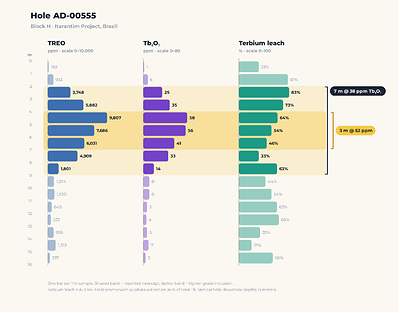
- New high-grade discovery at Block H: seven meters grading at 5,695 ppm TREO, 38 ppm Tb4O7, and 258 ppm Dy2O3, beginning just two meters below surface, including three meters at 7,841 ppm TREO, 52 ppm Tb4O7 and 357 ppm Dy2O3.
- Shallow and easily accessible: mineralization starts just two meters below surface, beneath minimal cover, in the near-surface clay horizon, making the discovery readily accessible for further drilling and evaluation.
- Strong terbium extraction: initial ammonium sulphate leach testing recovered 64%–83% of the terbium from the upper three meters of the enriched zone.
- Rich in high-value heavy rare earths: dysprosium and terbium oxides make up 5.2% of TREO in the Block H interval.
- Outside the existing Mineral Resource: Block H is not included in the current 1.1 billion tonne Mineral Resource, giving IMC a new area to test for potential resource growth.
- Next steps: (1) infill and step-out drilling to define the size and continuity of the new Block H discovery; (2) diamond and extension drilling at Block D, where the enriched zone is interpreted to continue and thicken beyond the depth reached by current auger drilling.
“Block H is exactly what we have been looking for: high-grade, terbium-rich clay starting just two meters from surface, with initial terbium extraction ranging from 64% to 83%,” said Frank Scolaro, Chief Executive Officer and Chair of IMC Rare Earths. “What makes this particularly exciting is that Block H sits entirely outside the 1.1 billion tonne resource we have already defined. One hole does not tell us how large this new zone may be, so our immediate priority is clear: keep drilling and determine how far it extends.”
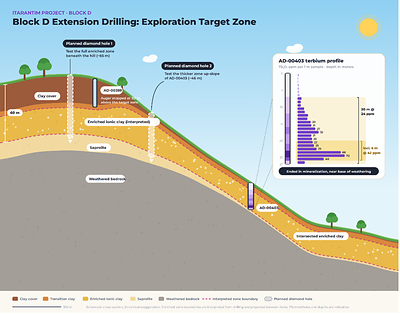
“Our second priority is Block D, where we have already intersected 20 meters of continuous mineralization, including nine meters at 24 ppm Tb4O7 averaging 72% terbium leachability, and six meters at 42 ppm Tb4O7. The hole ended while still in mineralization because the auger rig could not drill deeper, so we will now use diamond drilling to test the continuation of the zone. Together, Blocks H and D give us two clear opportunities to pursue as we work to grow and strengthen the Itarantim resource.”
Block H Discovery: A New Shallow, High-Grade Terbium Zone
Hole AD-00555, drilled vertically to 16 meters, intersected a continuous 7-meter mineralized interval beginning just two meters below surface. The mineralized interval includes a higher-grade 3-meter zone from four to seven meters, and an individual 1-meter sample returned 58 ppm Tb4O7. The shallow depth and concentration of terbium make Block H a priority for follow-up drilling. Assay results are summarized in Table 1 and shown in Figure 1.
Table 1. Significant intercept, hole AD-00555, Block H (grades in ppm)
|
From (m) |
To (m) |
Length (m) |
TREO |
MREO |
Nd2O3 |
Pr6O11 |
Dy2O3 |
Tb4O7 |
Y2O3 |
|
2.0 |
9.0 |
7.0 |
5,695 |
990 |
549 |
145 |
258 |
38 |
2,052 |
|
Including |
|||||||||
|
4.0 |
7.0 |
3.0 |
7,841 |
1,376 |
765 |
202 |
357 |
52 |
2,836 |
|
TREO: La2O3 + CeO2 + Pr6O11 + Nd2O3 + Sm2O3 + Eu2O3 + Gd2O3 + Tb4O7 + Dy2O3 + Ho2O3 + Er2O3 + Tm2O3 + Yb2O3 + Lu2O3 + Y2O3. MREO (magnet rare earth oxides): Pr6O11 + Nd2O3 + Tb4O7 + Dy2O3. Intervals are downhole lengths; all holes are vertical, so intervals approximate true thickness. |
Initial leach testing recovered 64% to 83% of the terbium from the upper three meters of the enriched zone. Mineralogical work across the broader Itarantim deposit has identified negligible deleterious elements in leached solution.
Block D: Thick, Continuous High-Grade Mineralization Extending Up-Slope
Block D provides IMC with a second potential area for resource growth. Hole AD-00403 illustrates the opportunity: it intersected 20 meters and ended while still in mineralization. Because mechanical auger drilling is limited to approximately 30 meters, IMC plans to use diamond drilling to test the continuation of the enriched zone at greater depth. Within the broader interval was a 9-meter interval from 14 to 23 meters averaging 24 ppm Tb4O7 with an average terbium extraction of 72% (Table 2; Figure 2).
Table 2. Significant intercept, hole AD-00403, Block D (grades in ppm)
|
From (m) |
To (m) |
Length (m) |
TREO |
MREO |
Nd2O3 |
Pr6O11 |
Dy2O3 |
Tb4O7 |
Y2O3 |
|
7.0 |
27.0 |
20.0 |
4,098 |
1,244 |
846 |
231 |
143 |
24 |
927 |
|
Including |
|||||||||
|
20.0 |
26.0 |
6.0 |
6,574 |
1,863 |
1,225 |
334 |
262 |
42 |
1,801 |
|
See Table 1 notes. |
Next Steps at Block H and Block D
The Company’s exploration program is now focused on two priorities intended to test the growth potential identified at Blocks H and D:
- Block H — define the size of the new discovery. Infill and step-out drilling around AD-00555 will test the extent, thickness and grade continuity of the shallow high-grade zone, with ammonium sulphate leach testing on all mineralized samples and collection of representative material for metallurgical (column leach) testwork. The objective is to define the size and continuity of the Block H discovery and determine whether it can ultimately be added to the Itarantim Mineral Resource.
- Block D — extension drilling. Diamond drilling to test the continuation of the enriched zone below the approximately 30-meter limit of auger drilling and up-slope from AD-00403, where the zone is interpreted to thicken (Figure 2). Step-out drilling will also test how far the thick, high-grade mineralization extends beyond AD-00403. The objective is to support potential growth of the existing 1.1 billion tonne Mineral Resource.
In parallel, the Company is selecting an engineering firm to evaluate potential processing methods for Itarantim, including vat, heap and in-situ leaching, supported by metallurgical testwork at ANSTO in Australia. Shallow, high-grade zones such as Block H will be assessed to determine whether they could support an earlier, lower-capital path to development. Ongoing drilling will support an updated Mineral Resource estimate expected later in 2026, including infill drilling at two areas of Block A aimed at upgrading portions of the current resource to the higher-confidence Indicated category.
Why Terbium and Yttrium Matter
Terbium is a heavy rare earth used in small quantities to help high-performance permanent magnets retain their strength at high temperatures. These magnets are important in electric vehicles, wind turbines and industrial equipment including data centers. Yttrium is used in advanced ceramics, optical applications and heat-resistant coatings for aerospace and energy. China’s export licensing controls on specified terbium and yttrium products have highlighted the vulnerability of manufacturers that depend on concentrated supply chains, and the U.S. Geological Survey reports that the United States was entirely net-import reliant for yttrium in 2025, with nearly all imported material derived from concentrates processed in China.
Drilling, Sampling and QA/QC
The Company’s technical team supervises drilling, with samples logged, photographed and processed under the Company’s exploration procedures. All holes are vertical (−90°) and sampled at one-meter intervals from surface. Samples are submitted to ALS in Vespasiano, Minas Gerais, for ME-MS81d (rare earth and trace elements plus whole rock) and ME-MS19 ammonium sulphate leach analysis. Sample batches include blanks, field duplicates and certified reference materials as part of the Company’s QA/QC protocol.
Qualified Person
The scientific and technical information in this news release, including the Exploration Target statement, has been reviewed and approved by Alexandre Rocha da Rocha, MSc, a Qualified Person as defined in Subpart 1300 of Regulation S-K. Mr. da Rocha is a geologist with more than 40 years of mineral exploration experience in Brazil and internationally, and is widely recognized as a pioneer of ionic adsorption clay rare earth exploration in Brazil. Mr. da Rocha played a central role in discovering the country’s first world-class deposits of this style, including the Rocha da Rocha Province in Bahia — which encompasses the Monte Alto deposit — together with Serra Verde’s Pela Ema deposit in Goiás and Aclara’s Carina Project in Nova Roma, Goiás. He holds a BSc in Geology (1986) and an MSc in Geosciences (1999) from the Universidade Federal do Rio Grande do Norte and is a Tenured Professor of Geology at the Federal Institute of Education, Science and Technology of Rio Grande do Norte (IFRN). Mr. da Rocha is Director of IMC Rare Earths and is not independent of the Company.
About IMC Rare Earths Ltd
IMC Rare Earths Ltd is a mineral exploration and development company focused on the exploration, development and long-term supply of rare earth elements. Its principal project is the Itarantim Project, an ionic adsorption clay rare earth deposit in the states of Bahia and Minas Gerais, Brazil.
Cautionary statement regarding Exploration Targets
The potential quantity and grade of Block H and Block D are conceptual in nature. There has been insufficient exploration to estimate a mineral resource in these areas, and it is uncertain whether further exploration will result in the estimation of a mineral resource. The Exploration Targets should not be construed to be, and do not represent, an estimate of a mineral resource or mineral reserve.
Forward-Looking Statements
Certain statements in this press release constitute forward-looking statements, including statements regarding the potential extent, grade and continuity of mineralization at Block H and Block D; the Exploration Targets; the potential for Block H to provide an early, high-grade source of feed or a starter area; terbium recovery and its variability; impurity characteristics; future drilling and metallurgical work; future resource additions and conversions; recovery, separation and product development; demand for and supply of rare earths; and the effects of export controls and geopolitical developments.
The Exploration Targets are conceptual in nature and there has been insufficient exploration to define a mineral resource at Block H or the Block D extensions. The Company has not established that reported exploration grades or laboratory extraction results will translate into commercially recoverable products or an economically viable operation, and no economic study has been completed on Block H.
Although the Company believes that the expectations expressed in these forward-looking statements are reasonable, it cannot assure you that such expectations will turn out to be correct, and actual results, including drilling and resource conversion outcomes, may differ materially from those anticipated. These forward-looking statements are subject to a number of risks and uncertainties, including, but not limited to: the economic viability of the Itarantim Project; the need for significant capital resources for its development; our ability to begin and sustain mining operations; our ability to manage our development, growth and operating expenses; our lack of operating history; the availability of suitable infrastructure and labor; delays or failures in the performance of third parties on which we rely; our ability to obtain and maintain necessary permits and licenses; outbreaks, epidemics or pandemics; mining industry operational risk; severe adverse weather conditions; reputational harm; our relationships with local communities and other stakeholders; changes in environmental and mining laws and regulations; the prices of or demand for rare earth elements; an adverse change in trade relations between the U.S. and Brazil; and those risk factors discussed in the Company’s filings with the Securities and Exchange Commission.
If any of these risks materialize or the assumptions prove incorrect, actual results could differ materially from those implied by these forward-looking statements. The Company undertakes no obligation to update or revise publicly any forward-looking statements, except as may be required by law.
Investor Relations Contact:
IMC Rare Earths Ltd, Investor Relations — info@imcrareearths.com

 View original content to download multimedia:https://www.prnewswire.com/news-releases/imc-rare-earths-discovers-new-high-grade-near-surface-terbium-zone-beyond-existing-1-1-billion-tonne-resource-at-block-h-itarantim-302901796.html
SOURCE IMC Rare Earths
