

IRVINE, Calif., April 1, 2026 /PRNewswire/ — Steven Farag, CEO of Campus Ink and NIL Store, is a veteran of the college sports apparel scene. Since the inception of Campus Ink’s NIL Store arm in 2021, his company has arranged licensing deals with more than 160 colleges and universities as well as 30,000 individual athletes. He has even attracted funding from billionaire entrepreneur, investor, and television personality Mark Cuban. With his expertise in the field and specialized Roland DG direct-to-film (DTF) digital printer, Farag has built a tremendously successful business around creating and selling custom T-shirts and accessories on-site and on-demand – also known as “hot market” apparel design and production. After cranking out thousands of uniquely customized garments during this year’s Big Ten Tournament, Farag and team have turned their attention to March Madness, including the men’s Final Four matchups at Lucas Oil Stadium in Indianapolis, Indiana and the Women’s Final Four in Phoenix, Arizona.
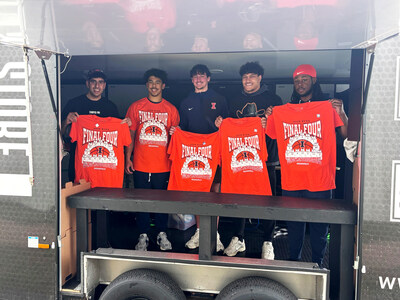
For both the Big Ten and March Madness tournaments, Farag has relied on his company’s “mobile” direct-to-film capabilities to get the job done. He and his crew have towed their specialized trailer carrying their Roland DG TY-300 direct-to-film printer and necessary supplies to tournament sites, where they set up shop and begin producing customized apparel — sometimes creating the designs for the T-shirts and accessories on the spot as the customers watch.
“Merchandise is now becoming an experience, and how something’s made is just part of that experience,” notes Farag. “You’re seeing on-demand customization and personalization popping up at events more and more – we’re taking it a step further by being able to design on the fly and show customers how it’s made. For the Big Ten games, we had athletes in our trailer, checking it out, working with our artists. Sometimes, we’ll show people an artist designing a shirt right there, and then rip it out in the trailer. It’s a huge shift in the printing industry to be able to get closer to the consumer and let them actually see how on-demand customized apparel is created. Plus, it definitely drives fan behavior – it gets people lining up.”
Farag is quick to point out an experience at the Big Ten tournament that illustrates his point. “During one of the games, an announcer made a comment after Michigan player Yaxel Lendeborg made an awesome three-pointer – he called it a ‘Triple Yaxel,” said Farag. “We put that on a shirt, and it was available in the United Center the next morning. So, that’s kind of how we do it – we’re able to be hyper-reactive to whatever the moment is in sports.”
This ability to respond quickly and efficiently to whatever is happening or trending at the moment is one of the primary reasons Farag’s on-demand apparel customization operation is so successful. “It’s very hard for the retailers that are running concessions in the stadium to gauge and forecast what they’re going to need,” he points out. “Eventually they’ll run out of one thing and have a ton of something else left over. What we wanted to be able to do with a DTF machine on-site in our trailer is help those retailers chase the right opportunities and hedge their inventory risk.”
At the Big Ten Tournament, the Campus Ink/NIL Store trailer was fully stocked and essentially on call for the retailers who run the concessions – they were able to let Farag and his team know exactly what they needed at any given time, allowing them to quickly produce the requested customized apparel items for the respective retailers. “We’re also able to print limited-edition shirts on very short notice,” added Farag. “For the last game of the tournament, we took the top player from Michigan and the top player from Purdue, put them both on a shirt, got that approved by all the different licensees overnight, and had them in the stadium the next morning.”
Being able to do this kind of rapid and on-the-spot customization requires not only the know-how, but also specialized equipment. According to Farag, he and his team needed to modify their trailer to create a mobile print environment that would allow them to transport and operate their TY-300 direct-to-film printer without any issues. First, they had to insulate the entire trailer and install baseboard heating, as DTF printers need to operate in a space within a specific temperature range and humidity level. The onboard heating system enabled them to run the TY-300 virtually non-stop – even when outside temperatures dropped below 20 degrees, as they did during the Big Ten games in Connecticut.
“We also wanted to be very careful about transportation,” said Farag. “To protect the DTF machine’s printheads, chips, and controllers while on the move, we built an air ride shock system in the trailer to make sure that if we hit a pothole, none of these sensitive components would be damaged. We were also concerned about power, but fortunately, the entire Roland DG system ran off 110 voltage, so we could run everything with one generator.”
Overall, Farag was thrilled about the way his direct-to-film printing system has functioned during the Big Ten Tournament as well as March Madness, and he’s expecting a repeat performance during the upcoming Final Four games in Indianapolis. “Our on-site production has been pretty magical to date,” noted Farag. “The three of us have been heat pressing, printing, and cutting as fast as we possibly could – we’ve been pushing the printer pretty hard, and it has kept up. I’d say the most demanding morning we’ve experienced so far was the Sunday of the Big Ten tournament, which involved a run of about 800 pieces. We started at 8 a.m. and finished around 1 p.m.”
Farag took a momentary break from his “Final Four” apparel customization planning to reflect on what he and his team have been able to accomplish so far. “Over the course of March Madness, we’ve supported a total of 87 teams on the men’s and women’s side. With 15 or 16 players per team, that’s over 1,300 players…and we’ve been able to print a design on the fly for each of them. That’s pretty incredible when you think about it. With our on-demand printing experience, and high-quality DTF equipment that’s uniquely designed for on-demand apparel customization, we can print designs and get the product to the consumer within minutes. Being able to do this allows us to not only satisfy the fans, but also help the sport and make money for the teams and athletes.”
To learn more about Campus Ink/NIL Store and the company’s on-site apparel customization, visit www.campus.ink and www.nil.store. For more information on the Roland DG TY-300 direct-to-film printer or the complete Roland DGA product line, visit www.rolanddga.com.
About Roland DG Americas
Roland DGA serves North and South America as the marketing, sales, distribution, and service arm for Roland DG Corporation. Founded in 1981, Roland DG of Hamamatsu, Japan is a worldwide leader in wide-format inkjet printers for the sign, apparel, textile, interior design, personalization, and vehicle graphics markets; engravers for awards, giftware and ADA signage; photo impact printers for direct part marking; and 3D printers and CNC milling machines for the dental CAD/CAM, rapid prototyping, part manufacturing and medical industries. To learn more about Roland DGA or Roland DGA’s complete product line, visit www.rolanddga.com.

 View original content to download multimedia:https://www.prnewswire.com/news-releases/big-ten-tournament-and-march-madness-hot-market-dtf-printing-with-campus-ink-302732064.html
SOURCE Roland DGA
