

First-of-its-kind Yuka–FLPC (Harvard Law School) study highlights how cheaper food products may expose consumers to higher health risks.
NEW YORK and BOSTON, March 3, 2026 /PRNewswire/ — New findings suggest that affordability in America comes at a nutritional cost. A groundbreaking study released today by Yuka and Harvard Law School’s Food Law and Policy Clinic (FLPC) reveals a stark truth about the American food industry: price strongly dictates food quality, to consumers’ detriment.
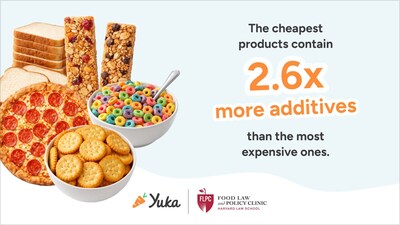
An analysis of over 800 food products shows that, across 12 of the most common processed food categories, the cheapest options contain 2.6 times more additives, 21% more sugar, and 10% more sodium than more expensive products. This pattern is consistent across everyday staples. In store-bought bread, the cheapest loaves contain nearly four times more additives than higher-priced options. In breakfast cereals, which are products heavily marketed to children, the cheapest options contain 77% more sugar, with a single serving reaching more than half of the World Health Organization’s recommended daily limit.
Taken together, these results demonstrate that nutrition is not simply a matter of personal choice, but rather a matter of access:
“This study highlights a two-tiered system within the American food industry,” said Julie Chapon, Co-Founder of Yuka. “Products with fewer additives and better nutritional profiles are consistently more expensive, while cheaper options are more heavily loaded with additives, sugar, and sodium. As a result, access to healthier food is constrained by price, turning basic nutrition into a privilege rather than a standard.”
The Affordability Trap
When Americans shop for food, price is undeniably a decisive factor. Products without high-risk additives cost, on average, 63% more than those that contain them, placing healthier options beyond what many households consider affordable. With nearly 70% of the nation’s packaged food supply now ultra-processed1, supplying more than half of adults’ daily calories and nearly two-thirds of children’s, this price discrepancy reveals a food system where affordability and health are fundamentally misaligned.2
“This creates a vicious cycle,” Chapon added. “A food system built on poorer nutritional quality at lower price points fuels diet-related disease and rising healthcare costs, while placing the greatest burden on those with the least access to healthier food and healthcare.”
A Regulatory System That Fails Consumers
This inequality is not accidental. It is the result of a U.S. food safety regulatory framework that is fundamentally reversed: instead of regulators imposing strict limits, food manufacturers are allowed to decide what is safe—an approach that often favors profits over public health.
“Urgent reform is needed to fix the U.S. food regulatory system,” said Emily Broad Leib, Clinical Professor of Law and Faculty Director of the Food Law and Policy Clinic at Harvard Law School. “Weak oversight and loopholes like the GRAS designation allow substances to enter and remain in the food supply without independent safety review, even when they are restricted or banned in many of our peer countries. Protecting public health requires stronger rules, greater transparency, and a regulatory framework that prioritizes nutrition over convenience.”
The health toll is staggering. Diet-related diseases now cost the United States more than $1 trillion annually, and recent estimates suggest that about one American dies prematurely every four minutes from conditions linked to ultra-processed foods – often high in additives, sugar, and sodium.34
A Path Forward
In addition to its findings, the report includes a detailed set of policy recommendations addressing the structural weaknesses in the U.S. regulatory system that allow potentially harmful chemical substances to remain widespread in the food supply, particularly in lower-cost and ultra-processed foods.
These recommendations pursue two complementary approaches:
- Modernizing food additive oversight through regulatory reform to strengthen accountability, close longstanding regulatory gaps, and increase transparency of the substances in our food.
- Reducing exposure to additives and ultra-processed foods through schools, public institutions, and fiscal policy measures (tax incentives) that improve access to healthier options.
Together, these recommendations aim to reduce harmful exposures, strengthen accountability across the food system, and better align U.S. food policy with public health goals.
The full report, Price vs Quality: The Hidden Costs of Low-Priced Food, is available at https://yuka.io/en/report-food-price-composition-us/.
About Yuka
Founded in 2017, Yuka is an entirely independent impact project. The app lets users scan the barcodes of food and cosmetic products to assess their health impact, with the aim of bringing more transparency to product composition and empowering consumers to make better choices for their health. Today, the app has over 80 million users worldwide, including 25 million in the United States. https://yuka.io/en/
About Harvard Law School’s Food Law and Policy Clinic
Since 2010, the Harvard Law School Food Law and Policy Clinic (FLPC) has provided legal and policy guidance on food systems issues in the U.S. and around the world. Through a collaborative and cross-disciplinary approach, FLPC promotes access to nutritious food, supports sustainable agricultural practices, and reduces food waste, while training the next generation of food law and policy leaders. For more, visit https://chlpi.org/food-law-and-policy
Media Contact:
Julie Chapon – julie.chapon@yuka.io / Natacha Favry – natacha@kalamari.agency
Emily Broad Leib – aezeokoli@law.harvard.edu / Ada Ezeokoli – aezeokoli@law.harvard.edu
Sources
1 Baldridge, Abigail S., Mark D. Huffman, Fraser Taylor, Dagan Xavier, Brooke Bright, Linda V. Van Horn, Bruce Neal, and Elizabeth Dunford. 2019. “The Healthfulness of the US Packaged Food and Beverage Supply: A Cross-Sectional Study” Nutrients 11, no. 8: 1704. https://doi.org/10.3390/nu11081704
2 Williams AM, Couch CA, Emmerich SD, Ogburn DF. Ultra-processed Food Consumption in Youth and Adults: United States, August 2021-August 2023. NCHS Data Brief. 2025 Aug;(536):10.15620/cdc/174612. doi: 10.15620/cdc/174612. PMID: 41027400; PMCID: PMC12516466.
3 The Rockefeller Foundation, True Cost of Food: Measuring What Matters to Transform the U.S. Food System (Jul. 2021), https://www.rockefellerfoundation.org/wp-content/uploads/2021/07/True-Cost-of-Food-Full-Report-Final.pdf.
4 Nilson EAF, Delpino FM, Batis C, Machado PP, Moubarac JC, Cediel G, Corvalan C, Ferrari G, Rauber F, Martinez-Steele E, Louzada MLDC, Levy RB, Monteiro CA, Rezende LFM. Premature Mortality Attributable to Ultraprocessed Food Consumption in 8 Countries. Am J Prev Med. 2025 Jun;68(6):1091-1099. doi: 10.1016/j.amepre.2025.02.018. Epub 2025 Apr 28. PMID: 40293384.

 View original content to download multimedia:https://www.prnewswire.com/news-releases/the-hidden-costs-of-low-priced-food-yukaflpc-harvard-law-school-study-finds-cheapest-products-contain-2-6-times-more-additives-302702865.html
SOURCE Yuca Corp
