

As the donor pool grows and more lifesaving transplants become possible, public education is more important than ever
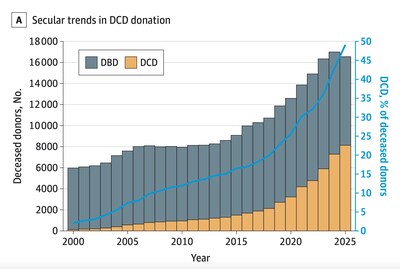
NEW YORK, Feb. 26, 2026 /PRNewswire/ — Organ donation after the heart stops beating, a practice called donation after circulatory death, has gone from rare to routine in the United States, a new study shows. This shift over the past 25 years, aided by technological advances, is helping to meet the growing demand for transplants, the authors say.
More than 100,000 Americans are currently waiting for a lifesaving transplant, according to the United Network for Organ Sharing. To address the shortage, experts have long searched for ways to safely and ethically increase the number of usable organs recovered from people who die.
Led by NYU Langone Health researchers, the new analysis traced how the deceased-donor pool has evolved because of these efforts. According to the results, circulatory-death donors climbed from 2% of all donors in 2000 to 49% of donors in 2025. Their organs are now a major source of kidneys and livers, and are increasingly used for lung, heart, and pancreas transplants.
“Our findings reveal that a rise in donations after circulatory death makes organ transplantation possible for thousands of patients who might otherwise die on the waitlist,” said study lead author Syed Ali Husain, MD, MPH.
Most donated organs historically came from people who were declared brain dead, notes Husain, an assistant professor in the Departments of Surgery and Medicine at the NYU Grossman School of Medicine. Because the heart continues to beat after brain death, their tissues continue to receive oxygen-rich blood.
By contrast, donation after circulatory death involves donors who do not meet criteria for brain death and who cannot be kept alive without life support machines. In these cases, if the family chooses to stop life support, it is then given the option to do so in an operating room instead of the intensive care unit. If the patient dies within a set time after support is removed, organs can be recovered and used for transplantation, preserving the opportunity to donate according to the wishes of the family and the patient.
Since the organs may briefly go without oxygen and nutrients as the body shuts down and the heart stops, they were previously considered to not function as well after transplantation compared to those recovered from brain-dead donors.
During the past decade, however, new tools have helped overcome this challenge and may explain the increased use of circulatory-death donation. For example, normothermic regional perfusion temporarily restores blood flow to organs that will be donated after the heart stops, and machine perfusion devices pump nutrient- and oxygen-rich fluid through organs after removal from the body. Both approaches limit damage and make more organs suitable for transplantation.
These advances may also enable surgeons to use organs from people who would once have been excluded, the authors say. The study showed for the first time that today’s circulatory-death donors tend to be older, have a higher body mass index (a measure of obesity), and are more likely to have health conditions such as diabetes or high blood pressure than similar donors in earlier years.
A report on the findings will be published online Feb. 26 in the Journal of the American Medical Association.
For the investigation, the researchers analyzed data from the Organ Procurement & Transplantation Network, which tracks every organ recovered in the U.S. They calculated the yearly share of circulatory-death donors and the resulting kidney, liver, lung, heart, and pancreas transplants. The team also assessed recovery patterns across the 55 organ procurement organizations in the U.S. — regional nonprofit agencies that coordinate donation in their assigned areas.
The researchers found that in some parts of the country, donation after circulatory death was far more common than in others, with shares ranging from as high as 73% of donors to as low as 11% of donors.
“Our results highlight the opportunity to further grow donation after circulatory death and save even more lives,” said study co-senior author Dorry Segev, MD, PhD. Segev is a professor and vice chair in the Department of Surgery at the NYU Grossman School of Medicine and the director of the school’s Center for Surgical & Transplant Applied Research (CSTAR).
“Clear, consistent standards for donation after circulatory death are important so patients are protected and the public is assured that the process is safe,” said study co-senior author Babak Orandi, MD, PhD, an associate professor in the Departments of Surgery and Medicine at the NYU Grossman School of Medicine.
“As donation after circulatory death becomes more common, expanded education and dialogue with patients, families, and clinicians will be essential to maintaining that trust,” added study co-author Macey Levan, JD, PhD, an associate professor in the Departments of Surgery and Population Health at the NYU Grossman School of Medicine.
According to Levan, the researchers next plan to explore ways to improve donor identification and recovery practices, as well as examine how well organs from circulatory-death donors perform over time compared with those from brain-dead donors.
National Institutes of Health grant K23DK133729 provided funding for the study.
Along with Husain, Segev, Orandi, and Levan, NYU Langone researchers involved in the study are Jennifer Motter, MHS; Darren Stewart, MS; Sunjae Bae, MD, PhD; Brendan Parent, JD; Bonnie Lonze, MD, PhD; Philip Sommer, MD; Sommer Gentry, PhD; Jeffrey Stern, MD; and Allan Massie, PhD.
Husain has received consulting fees from the pharmaceutical company Novartis, Orandi has served on an advisory board for the pharmaceutical company Boehringer Ingelheim, and Stewart has received consulting fees from Hansa Biopharma. None of these activities are related to the current organ donor study. NYU Langone Health is managing the terms and conditions of these relationships in accordance with its policies and procedures.
About NYU Langone Health
NYU Langone Health is a fully integrated health system that consistently achieves the best patient outcomes through a rigorous focus on quality that has resulted in some of the lowest mortality rates in the nation. Vizient Inc. has ranked NYU Langone No. 1 out of 118 comprehensive academic medical centers across the nation for four years in a row, and U.S. News & World Report recently ranked four of its clinical specialties number one in the nation. NYU Langone offers a comprehensive range of medical services with one high standard of care across seven inpatient locations, its Perlmutter Cancer Center, and more than 320 outpatient locations in the New York area and Florida. The system also includes two tuition-free medical schools, in Manhattan and on Long Island, and a vast research enterprise.
Media Inquiries
Shira Polan
212-404-4279
Shira.Polan@NYULangone.org

 View original content to download multimedia:https://www.prnewswire.com/news-releases/more-organ-donations-now-come-from-people-who-die-after-their-heart-stops-beating-302698181.html
SOURCE NYU Grossman School of Medicine and NYU Langone Health
