

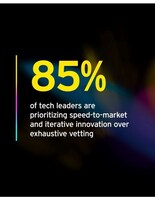
- 85% of technology leaders prioritize speed-to-market over exhaustive AI vetting
- 52% of department-level AI initiatives are operating without formal approval or oversight
- 45% of technology executives report a confirmed or suspected sensitive data leak in the last 12 months
NEW YORK, March 5, 2026 /PRNewswire/ — Ernst & Young LLP (EY US) today released its latest Technology Pulse Poll, which finds technology leaders advancing their autonomous artificial intelligence (AI) ambitions, even as governance and oversight capabilities struggle to keep pace. Autonomous AI refers to highly independent AI systems that can understand, learn and perform any intellectual task at or above human capability across a wide range of domains. The poll, conducted in February 2026, surveyed 500 US business leaders working within the technology industry.

Results show that 97% of technology executives view the pursuit of broad autonomous AI as a “high” or “essential” priority for their organization’s long-term competitive strategy. Tellingly, the survey suggests a growing AI challenge: executives report that over half (52%) of department-level AI initiatives are operating without formal approval or oversight and 78% of leaders say AI adoption is outpacing their organization’s ability to effectively manage the business risks associated with these projects.
“Technology companies continue to move at remarkable speed in their pursuit of autonomous AI,” says James Brundage, EY Global and Americas Technology Sector Leader. “While leaders see it as essential to long-term competitiveness, many acknowledge that adoption is outpacing oversight and that a significant share of AI initiatives lack robust governance. Without strong governance in place, companies risk hitting a plateau where large-scale transformational growth and innovation across the enterprise become increasingly difficult. That’s the velocity paradox leaders are navigating today, balancing urgency with accountability.”
Oversight gaps are already creating real-world consequences
In the last 12 months, 45% of technology executives say their organization experienced a confirmed or suspected leak of sensitive data due to employees using unauthorized third-party generative AI tools and 39% report confirmed or suspected proprietary IP leaks for the same reason.
Investment picks up speed – with security at the top of the list
Despite the risks, technology leaders continue to expand investment in AI. According to the survey, 95% of executives say AI spending at their company will increase in the next year, up from 92% in last year’s survey. As AI adoption speeds up, security vulnerabilities increase exponentially. As such, 79% of leaders say they plan to increase AI investments in cybersecurity, followed by cloud computing (67%), AI-specific talent (65%), compute and infrastructure (62%) and back-office functions such as IT, finance and HR (56%).
“Investment momentum remains strong, particularly in cybersecurity, infrastructure and AI-specific talent,” says Ken Englund, EY Americas Technology Sector Growth Leader. “Organizations that standardize approved tools, strengthen monitoring and security controls and invest in workforce enablement will be better positioned to scale safely and achieve their AI ambitions with manageable risk.”
Geopolitical volatility and sovereign AI mandates complicate AI growth plans
Technology executives also cite macro-level constraints on AI scale. In fact, 62% say they are concerned that escalating geopolitical tensions or sovereign AI mandates will hinder their organization’s ability to scale AI initiatives.
Other key findings from the EY Technology Pulse Poll include:
- Speed-to-market defines AI strategy: 85% of tech executives say their organization prioritizes speed-to-market and iterative innovation, managing regulatory and ethical risks as the technology evolves in a real-world environment, while only 15% prioritize exhaustive pre-launch vetting and total regulatory alignment.
- Governance authority and empowerment are paramount: 50% say their AI governance or ethics leaders have full independent authority to halt high-priority or revenue-generating AI projects that fail established safety and ethical guardrails, while 42% say such authority requires the intervention or approval of the board or CEO.
- Centralization is standard: 70% report using a centralized operations model to manage AI approvals and guardrails across the organization. It’s important to note that AI maturity and sector often influence governance models, which bring different benefits and challenges. Across the technology sector, organizational evolution is commonly associated with a move away from centralized models toward federated models anchored in core interoperability standards.
About EY
EY exists to build a better working world, helping to create long-term value for clients, people and society and build trust in the capital markets.
Enabled by data and technology, diverse EY teams in over 150 countries provide trust through assurance and help clients grow, transform and operate.
Working across assurance, consulting, law, strategy, tax and transactions, EY teams ask better questions to find new answers for the complex issues facing our world today.
EY refers to the global organization, and may refer to one or more, of the member firms of Ernst & Young Global Limited, each of which is a separate legal entity. Ernst & Young Global Limited, a UK company limited by guarantee, does not provide services to clients. Information about how EY collects and uses personal data and a description of the rights individuals have under data protection legislation are available via ey.com/privacy. EY member firms do not practice law where prohibited by local laws. For more information about our organization, please visit ey.com.
Ernst & Young LLP is a client-serving member firm of Ernst & Young Global Limited operating in the US.
Survey methodology
EY US commissioned Atomik Research to conduct an online survey of 500 US business leaders working within the technology industry. Participants held roles similar or equivalent to director, vice president, senior vice president, executive vice president, C-suite or president. Business leaders surveyed worked at organizations consisting of 5,000 or more employees. The margin of error is +/- 4 percentage points with a confidence level of 95%. Fieldwork took place between January 30 and February 17, 2026.
Contact:
Sara Nazarian
Sara.Nazarian@ey.com
+ 1 213 977 3200

 View original content to download multimedia:https://www.prnewswire.com/news-releases/ey-survey-autonomous-ai-adoption-surges-at-tech-companies-as-oversight-falls-behind-302704837.html
SOURCE EY
