

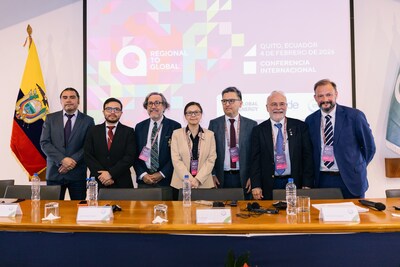
QUITO, Ecuador, Feb. 7, 2026 An international Regional to Global conference dedicated to the energy transition in Latin America was held in the capital of Ecuador. The forum brought together more than 150 participants – scientists, experts and industry representatives from Bolivia, Brazil, Chile, Ecuador, Puerto Rico, Russia, the United States and Uruguay – as well as specialists from the Latin American and Caribbean Energy Organization (OLACDE). Ambassadors and diplomats from several countries took part in the conference.
Fitzgerald Cantero Piali, OLACDE Director of Studies, Projects and Information, pointed out that the share of renewable energy sources in the region’s power generation has already reached 67% and could increase to 76% by mid-century. He also recalled that more than half of the world’s lithium reserves are concentrated in Latin American countries and highlighted the prospects for the development of green hydrogen and biofuels.
Hortensia Jiménez Rivera, Director General of the Bolivian Nuclear Energy Agency, stressed the need for a comprehensive energy policy focused not only on decarbonization but also on energy security and energy justice. According to her, nuclear power and nuclear technologies can play a complementary role in achieving these goals.
Isolda Costa, Technical-scientific Director, Brazilian Association of Nuclear Energy, presented a project for a network of microreactors designed to supply power to remote and isolated areas. She noted that around 16 million people in the region still lack stable access to electricity.
Sergey Machekhin, Deputy General Director of PJSC RusHydro for project engineering, sustainable development and international cooperation, drew attention to the key role of hydropower in ensuring the resilience of energy systems and cautioned against mechanically following the low-carbon agenda without taking national specifics into account.
This view was supported by Nelson Gutiérrez, research professor at UTE University, who recalled the risks revealed during last year’s blackout in Spain, where the share of wind and solar generation in the system at one point approached 90%. As an alternative, he proposed integrating microhydro turbines into existing water supply systems.
Erik Escalona Aguilar, professor at the University of Lleida, spoke about Chile’s plans to increase the share of renewables in the national energy mix, noting that renewable energy will account for the majority of investments in the coming years. Prominent Chilean scientist José Zagal highlighted the chronic underfunding of science in the region despite its strategic importance.
Practical solutions for isolated territories were presented by Héctor D. Abruña, Director of the Center for Materials Research at Cornell University, who spoke about an autonomous microgrid project in Puerto Rico based on renewable hydrogen produced using solar energy and storage systems.
The conference also featured the award ceremony honoring the first female laureate in the history of the Global Energy Prize – Yu Huang, Professor in the Department of Materials Science and Engineering at University of Los Angeles, California.
The nomination cycle for the 2026 Global Energy Prize was launched in January. Applications will be accepted until April 20 at the Global Energy website.
 View original content to download multimedia:https://www.prnewswire.co.uk/news-releases/the-future-of-the-energy-transition-in-latin-america-discussed-in-ecuadors-capital-at-the-global-energy-association-conference-302681850.html
