

Why soft skills are more important than ever in life sciences
We all know or work with people who can be difficult to deal with and even talk to, and we all know or work with other people who are a joy to be around and who make the working day a little brighter.
Some of those difficult people will be highly competent in their field; their technical knowledge will be deeper than most – and they will know it.
But is technical competence enough? Do organisations need only that in order to thrive, or are soft skills (like communication, teamwork, and leadership) equally important?
A recent report the highest levels of professional attainment.
The report notes; “Put simply, as technical complexity rises, the glue that keeps talent productive is social skill—communication, empathy, conflict resolution, and the ability to coordinate diverse expertise”.
Soft skills, then, are those personal attributes, traits, and abilities that determine how you interact and work with others – helping you to navigate the complexities and challenges of the workplace, like difficult personalities, conflict, and shifting priorities.
They are vital for effective collaboration and, unsurprisingly, highly valued by employers.
In this article we look at how organisations are embracing new technologies, such as VR and AI, to help develop those soft skills; and we highlight the issues faced by the medicines manufacturing sector to illustrate the importance of soft skills in life sciences.
Life skills
The life sciences sector is a priority for the UK Government and a huge employer of highly-skilled scientists and engineers, along with many others working in support or administrative roles.
But there is a critical skills shortage in some areas; for example, one report 70,000 new and 75,000 replacement jobs will be needed in medicines manufacturing in the next 10 years, as new medicines are approved that require complex handling and processing.
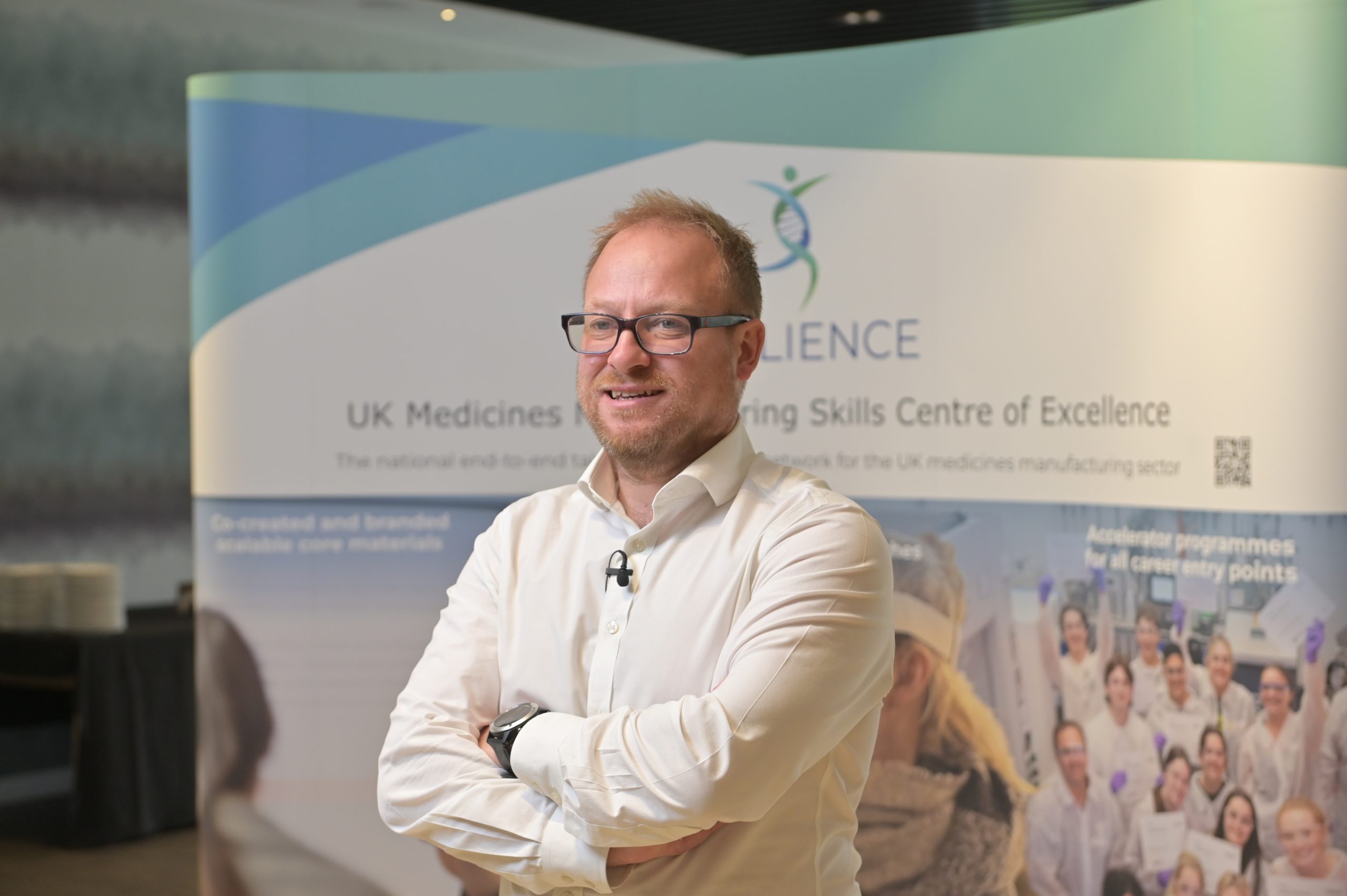
The government has responded to this by creating Resilience Manufacturing Skills Centre of Excellence; it is a 2-year, £4.5 million programme designed to excite, engage, and attract young people to work in the sector, and it uses advanced VR technology to deliver core laboratory and manufacturing skills.
Critically, it also uses AI-powered VR technology to develop soft skills, creating and learning from customisable roleplay.
VR offers many benefits for this kind of learning; users can be put into highly typical real life scenarios, such as a difficult conversation or job interview, where they interact with virtual avatars. Crucially, they can replay the scenario over and over, trying new approaches and building confidence.
AI tools can analyse users’ behaviours and actions (speech, body language, decisions) and provides immediate insights to guide improvements.
Perhaps most importantly, users can literally try seeing the scenario from other perspectives (for example, a colleague’s), which creates empathy and allows the user to see how they come across to a third party.
While the idea of watching ourselves back, for example in an interview, is enough to make most people squirm, it can reveal aspects of our behaviour (mannerisms, delivery, and body language, for example) that we’re likely unaware of.
Finally, VR training can be delivered anywhere and scaled at will, so is highly cost-effective.
Talk talk
Collaborative working is essential in the modern workplace, perhaps even more so in the life sciences sector, where scientists work on highly advanced biology and medicines.
The scientist caricature is brilliant, eccentric, lacking social skills, and typically hopeless at communicating, the core enabling skill that underpins teamwork.
Good, effective, communication can mean the difference between success and failure – and the most significant part of communication is listening.
Of course, the best approach is to ensure the organisation attracts and retains the right people in the first place. As the wise saying goes, hire for attitude, train for skills.
The most important of those skills, as noted above, is undoubtedly communication, from which everything else flows; clear communication means almost by definition using appropriate language – not shouting, or looking down on your listeners. And it engenders respect and trust.
It doesn’t matter if you are right, or know more than anyone else about something, if you can’t communicate your meaning clearly such that your interlocutors understand then it’s a waste of time.
As Einstein said; “If you can’t explain it simply, you don’t understand it well enough.”
Of course, there is another side to this coin; and another quote captures it in the form of advice and observation; “When people talk, listen completely. Most people never listen.” That was Ernest Heningway.
On a related note, Stephen Covey said; “Most people do not listen with the intent to understand; they listen with the intent to reply.” And from further back, La Rochefoucauld observed; “We never listen when we are eager to speak”. This (not listening, and being ready to pounce with your Tuppence-worth) is particularly pernicious, resulting in frustration and loss of trust; but when highlighted to an offender it can be quickly corrected.
Other soft skills that are highly valued include adaptability, work ethic, and emotional intelligence. They can help you stand out in a competitive job market.
Talking of which, here’s a final extract from the Harvard Business Review analysis; “We found that those who scored highly on basic skills were more likely to earn higher wages throughout their careers, move into more advanced roles, learn specialized skills more quickly, and were more resilient to industry changes. The presence and development of foundational skills didn’t just make workers more competitive for entry level jobs—they determined how far they could climb the career ladder.”
In the Resilience programme, we recognise how important it is for scientists and engineers to communicate effectively, and we have developed the tools and technology to help them improve this primary soft skill.
Conclusions
Soft skills matter. They foster teamwork, collaboration, and a healthy, happy, workplace.
Most importantly, they can be learned and developed; AI and VR are powerful tools for training in soft skills.
Of course, not every company needs to be so reliant on soft skills; start-ups may need ‘instant’ technical expertise, and high-turnover operations may simply not care, but for the vast majority of workplaces soft skills really matter – a lot.
Given the critical skills shortages in some parts of the UK’s life sciences sector, it is vitally important that we not only find highly qualified scientists and engineers, but also ensure that they are ready to work in and contribute to a collaborative, supportive, respectful, and trusting environment.
Communication is the core skill that underpins everything, and it cuts both ways; articulating your point clearly is vital, but so is actively listening.
As George Bernard Shaw put it; “The single biggest problem in communication is the illusion that it has taken place.”
About Resilience
Resilience is the UK Medicines Manufacturing Skills Centre of Excellence. It is a £4.3 million programme funded by the Office for Life Sciences, part of the UK Government’s Department for Science, Innovation & Technology, and managed through Innovate UK.
The two-year programme, which started in April 2024, uses virtual reality to train medicine makers in core skills which would be impractical, disruptive, and expensive to gain in the real world.
Partner organisations across the UK delivering the programme include the University of Birmingham, University College London (UCL), Teesside University, Heriot-Watt University and Britest. Professor Ivan Wall of the University of Birmingham and Professor Gary Lye of UCL are co-directors.
As well as bridging the skills gap, Resilience is helping the NHS to meet its long-term goal of achieving net zero. 25% of NHS emissions are in the supply chain, and VR will help the industry deliver net zero medicines manufacturing by reducing laboratory waste.